Showing posts with label Omnibus. Show all posts

Wednesday, May 1, 2019

Review- THE AMAZING SPIDER-MAN OMNIBUS VOL. 2


THE AMAZING SPIDER-MAN OMNIBUS VOL. 2 (Marvel, First Printing, 2012; Hardcover)

Collects The Amazing Spider-Man #39-67, Amazing Spider-Man Annual #3-5, The Spectacular Spider-Man #1, 2, and the Spider-Man stories from Not Brand Echh #2, 6, 11 (cover dates August, 1966- December, 1968)

Writer: Stan Lee

Artists: John Romita, Sr. with Don Heck, Larry Lieber, Jim Mooney, Marie Severin, Mike Esposito, Bill Everett, and Frank Giacoia


While I love Steve Ditko, I prefer the artwork of John Romita, Sr. a whole lot more. I remember teenage me arguing with some nerds at the comic shop circa 1987. This guy said Ditko all the way. I argued that Ditko is great and laid the foundation, but it was John Romita, Sr. who defined the contemporary Spider-Man that we know and love. This was right before Todd McFarlane would do a hard reset and make Ditko the only acceptable reference point for the character for decades to come. Those of us who were Bronze Age children know Romita's version as the one who adorned t-shirts and luncboxes.


This stuff is art of the highest order. There are too many highlights for me to do a blow by blow, but I'll take a shortcut and tell you that if you are not familiar with this run that it is top shelf material and it belongs in everyone's library.


The OCD zone- This is the part where I go into tactile sensations and materials used in physical media. Those with heart conditions, high blood pressure, or women who are pregnant should exit my blog at their earliest convenience, as their safety cannot be guaranteed beyond this point.


PLEASE NOTE THAT THE FOLLOWING APPLY TO THE 2012 FIRST PRINTING OF THIS BOOK.

Linework and Color restoration: There are a couple of issues here which look like they could be improved upon if better source material surfaced. I am uncertain if the second printing of this book used any original artwork which may have surfaced since this book was released.


Paper stock: Coated stock with a slight sheen. This is closer to glossy than matte.

Binding: Sewn binding. Like many older Omniboo, this has developed the dreaded Omnibus sag due to gravity and the weight of the book block. Some folks use post it note pads to prop up the block, others store them spines down. I like to live dangerously and store my books vertically.

Dustjacket and Hardback cover notes: Laminated dustjacket. The hardback has faux leather grain and dye foil stamping. The second printing does not have that.


The hardback has ugly creases on it after reading it.

Thursday, March 21, 2019

Review- BATMAN: THE BRAVE AND THE BOLD- THE BRONZE AGE OMNIBUS VOL. 1


BATMAN: THE BRAVE AND THE BOLD- THE BRONZE AGE OMNIBUS VOL. 1 (DC, First Printing, 2017; Hardcover)

Collects The Brave and the Bold #74-109 (core stories only; none of the back-up stories are included) (cover dates November, 1967- November, 1973)

Writers: Bob Haney, Mike Sekowsky, and Denny O'Neil

Artists: Pencilers- Ross Andru, Neal Adams, Mike Sekowsky, Bob Brown, Irv Novick, Nick Cardy, Carmine Infantio, and Jim Aparo; Inkers- Mike Esposito, Jack Abel, Neal Adams, Dick Giordano, Vince Colletta, Irv Novick, Joe Kubert, Nick Cardy, Murphy Anderson, Jim Aparo, and Frank McLaughlin


DC has really closed the quality gap when compared to Marvel's Omnibus editions. I prefer the paper stock that DC has been using over the decontented stock Marvel has been using in theirs for the past few years. The binding, while stiffer, feels sturdier than Marvel Omniboo. We'll see if it develops Omnibus sag like the older Marvel ones do. Both companies have cheapened the hardback boards and casewrap.

Awful gradient shading. 

The OCD zone- This is the part where I go into tactile sensations and materials used in physical media. Those with heart conditions, high blood pressure, or women who are pregnant should exit my blog at their earliest convenience, as their safety cannot be guaranteed beyond this point.

Issue 84 had a two page spread which was broken up on pages 265 and 266. While it is a subtle spread Bruce Wayne's head does continue across both pages in the original issue. This effect is ruined in this book.

Linework and Color restoration: Hit and miss when it comes to the coloring. Some of the restoration work has been repurposed from the Legends Of The Dark Knight: Jim Aparo hardcover and the Diana Prince, Wonder Woman trades. Those issues have awful, lazy gradient shade blends. While subtle to normal humans, they stab into my eyes like hot needles.

The issues which were freshly recolored for this book (INCLUDING the Neal Adams ones!!!) look terrific. Those of us who suffered through Adams' George Lucas Special Edition bastardization of these issues in those Batman By Neal Adams line can rejoice in the fact that history has been corrected.

Scan of the original comic.
Restoration found in this book.

The linework is very good throughout, although I did not go page by page and panel by panel. I might have missed something, but the handful of spot checks that I did looked good. 

Paper stock: I love the matte coated stock DC uses in their Omniboo. Top shelf stuff.

Binding: While the sewn binding is stiffer than Marvel's, the book as a whole feels sturdier.

Dustjacket and Hardback cover notes: The dustjacket has glossy lamination. The casewrap of the hardback is the sole drawback here, as it feels cheap.

Saturday, September 8, 2018

Review- SPIDER-MAN BY ROGER STERN OMNIBUS


SPIDER-MAN BY ROGER STERN OMNIBUS (Marvel, First Printing, 2014; Hardcover)

Collects Peter Parker, The Spectacular Spider-Man #43-61, 85, The Amazing Spider-Man #206, 224-251, and Amazing Spider-Man Annual #16, 17 (cover dates June, 1980- May, 1984)

Writers: Roger Stern with additional writing by Marv Wolfman, Steve Leialoha, Bill Mantlo, Marie Severin, Jan Strnad, and Tom DeFalco off of plots by Roger Stern

Artists: Pencilers- John Romita, Jr., Ron Frenz, John Byrne, Denys B. Cowan, Bob Hall, Ed Hannigan, Greg LaRocque, Rick Leonardi, Steve Leialoha, Luke McDonnell, Al Milgrom, Jim Mooney (also inking), Marie Severin, Jim Shooter, and Mike Zeck

Inkers- John Romita, Sr., Terry Austin, Brett Breeding, Vince Colletta, Gene Day, Kevin Dzubian, Frank Giacoia, Al Gordon, Dan Green, Dave Humphrys, Klaus Janson, Bob Layton, Pablo Marcos, Steve Mitchell, Bruce Patterson, Josef Rubinstein, Dave Simons, Frank Springer, and Bob Wiaceck


I've bought and read these comic books so many times across various formats over the past 35 years. I go into greater detail in my previous reviews of this material: Essential Spider-Man Vol. 10 and Vol. 11, Spider-Man: Nothing Can Stop The Juggernaut, and Spider-Man: Origin Of The Hobgoblin.


If you are done reading those nostalgic ramblings linked above then you are about to be subjected to more. I feel lucky to have been a 9.5 year old kid on that cold morning of January 9, 1983, when my mom let me get one of those Whitman three-packs of Marvel Comics at Farmer Jack (RIP). I didn't realize that I was witnessing the dawn of a villain who would go on to dominate the next four years of the title, or that I was reading something by a writer whose run would go down in history as one of the best in the history of the character. I was just a kid who liked reading comics and was bit by the collector bug that day.


Stern starts off slow over in Peter Parker, The Spectacular Spider-Man, but over the course of his 19 issue run he finds his voice with the character. By the time he gets promoted to the flagship title, The Amazing Spider-Man, he has shifted into high gear. We see the rebirth of The Vulture, an outstanding issue with the Foolkiller, and a two-part Black Cat story which would set the stage for what Al Milgrom would build on over in Peter Parker, The Spectacular Spider-Man.


Stern did lots of two-parters. 229-230 are the legendary Nothing Can Stop The Juggernaut, which are possibly the most inspiring underdog comic books of all time. I am sucker for the Cobra/Mr. Hyde two-parter (231-232) ever since I got a quarter box copy of 231 back in 1983. 238 and 239 were the introduction of The Hobgoblin, with 240 and 241 showing the Vulture as a major contender, something not truly seen since the '60s.


After that Stern plays it a little looser, running subplots behind the main issue's action, all building toward #250. Then Stern decided to jump ship for reasons I'm unsure of. Tom DeFalco comes on board without missing a beat, and his run is as much a favorite of mine as Stern's.


I can't wait to buy this material again when the Marvel Masterworks reach this era. Kill me now.
Junk Food For Thought rating: 5 out of 5.


The OCD zone- This is the part where I go into tactile sensations and materials used in physical media. Those with heart conditions, high blood pressure, or women who are pregnant should exit my blog at their earliest convenience, as their safety cannot be guaranteed beyond this point.

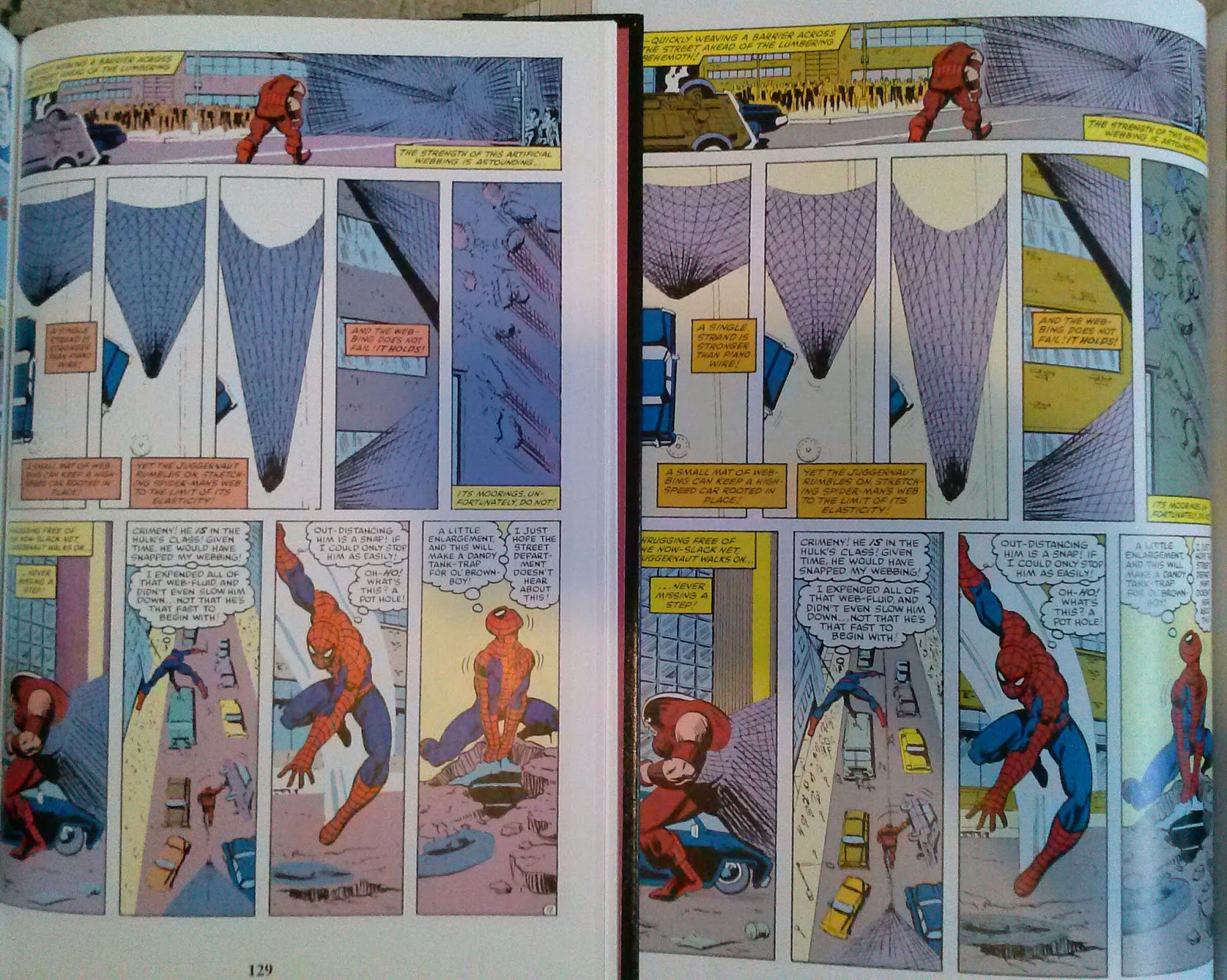
Linework and Color restoration: This is the Blu-Ray/4k version of these comics. While they have been remastered before for various collections, many of these issues were remastered again by the same team which does the state-of-the-art Marvel Masterworks.

Left: Nothing Can Stop The Juggernaut PHC restoration. Right: This book's restoration. Night and day. 


Paper stock: Lightweight coated stock with a slight sheen to it. Marvel switched to a thinner paper in their Omniboo back in 2013 and I don't like it as much. The only plus that I can give this paper stock is that it makes the book lighter. This book is nearly 1,300 pages as it is, and it was still a heft beast.

Binding: Sewn binding. The book lies completely flat, a real feat when you are dealing a book this size. The downside with Marvel's more flexible binding is that the heavy book block has a tendency to sag a pinch when stored vertically. Many collectors advise storing these book horizontally, while others customize Post-It note pads to the exact height necessary to support the opposite end of the binding. I'll be dead and gone before this is a concern and my kids can deal with this crap.


Dustjacket and Hardback cover notes: The dustjacket has the same high quality lamination and weight as always, but it's the casewrap which has been decontented with the 2013-on Omnibus book. Gone are the faux leather grain and dye foil stamping, in are paperwrap with a chintzy coating which is easily scuffed. 

Saturday, July 29, 2017

Review- SPIDER-MAN BY TODD McFARLANE OMNIBUS


SPIDER-MAN BY TODD McFARLANE OMNIBUS (Marvel, First Printing, 2016; Hardcover)

Collects Spider-Man #1-14, 16 and X-Force #4 (cover dates August, 1990- November, 1991)

Writer and Artist: Todd McFarlane with Writing by Fabien Nicieza and Rob Liefeld (X-Force #4), artwork by Rob Liefeld (X-Force #4) and additional Inking by Rick Maygar, Scott Williams, and Jim Lee


Todd McFarlane's adjective-less Spider-Man series, released during the summer of 1990, was, for all intents and purposes, the opening bell for the speculator bubble of the 1990s. We all know what happened, we all know why it happened, and we all see aspects of it being repeated by the industry today.

McFarlane was a breath of fresh air when he exploded on the scene in Amazing Spider-Man back in November of 1987*. I was a first day buyer back then and was immediately taken aback by this bold new take on the character. His version was like a creepier version of Steve Ditko's Spider-Man. He had been in the business for a few years already but he was new to me .

*Comic cover dates were four months ahead when purchased in Direct Market, or comic specialty shops as we called them back then. Cover dates were three months ahead on newsstands like 7-11. By the time that this adjective-less series hit the stands cover dates had been adjusted to being two months ahead for the DM, three for newsstands.

This was among the first Marvel series to be structured in arcs, with each issue being Part _ of _ of said story title. This was done so that it could be repackaged into books for the emerging trade paperback market for mainstream bookstores. As strange as it may sound here in 2017, there was a time when Marvel did not think of the collected edition when making their comic books. The full bleed artwork was also a new thing at the time.

This dark take on the character was fascinating because it simply hadn't been done before. The Horror elements are brought to the fore in this series. While McFarlane would like to make this out to be a more adult take on the character, his sexual double entendres are adolescent and embarrassing to read as an adult. This being the dawn of the '90s, !!!totally extreme!!! thinking was the order of the day. To be fair, the action sequences are a blast. McFarlane's exaggerated anatomy and almost cartoony depictions of people give his art a unique look which would be aped by numerous artists and become a cliché. Credit where credit is due, he did this stuff first and he did it the best. Motion lines, excessive detail, and unrealistic anatomy would dominate most of the 1990s because of him.


The first arc of five issues has been repackaged numerous times as Torment. This is the Lizard as his most brutal. The endless DOOM DOOM DOOM DOOM DOOM sound effect jungle drum beats got old fast, especially since this wasn't the first time that I've read this material. My son wanted to read this book with me but bailed after five issues. He seemed bored with this, which kind of surprised me. I figured that the fast pace of McFarlane's stories would be right up his alley but I was wrong.

The second arc, Masques, has also been repackaged multiple times. I had the old original UK trade years ago but dumped it because I predicted this book once Marvel rereleased these arcs in Premiere Classic hardcovers. It may have taken several years for this to become reality but I have nothing but time and no shortage of stuff to read. McFarlane's take on the Hobgoblin and Ghost Rider both leave me cold.


The cover to the first issue of the third arc (Perceptions, also repackaged like Masques) is one of those boring, 'iconic' type of covers that have little to do with the interior and would plague comics in the early 2000s. Awful and lazy. The arc itself is very good, with Spider-Man teaming up with Wolverine to take on the Wendigo. Subtlety is something completely lost on McFarlane, and he drills his opinion of the then-emerging 24/7 news cycle into you. I'm old enough to remember when news was about reporting a story instead of creating one. The sensationalism spotlighted here seems downright tame when compared to clickbait garbage reporting that passes as news today.

My beloved Morbius The Living Vampire was the surprise villain in the fourth arc of the series, Sub-City. The writing in this one is pretty weak but there's plenty of action and Morbius so who cares. The book closes out with the godawful sideways X-Force crossover, Sabotage. X-Force sucks and Rob Liefeld sucks. Both are the epitome of everything wrong with mainstream 1990s comics, and I cannot spit enough venom at either one.


This being Marvel, there is an exhaustively researched section of DVD-style extras in the back. All variants and industry magazine covers, as well introductions and covers from previous editions of the various collections are included. This run means a lot to fans 10 or more years younger than I am. It's not the best era as far as I'm concerned but it's a fun enough read and serves as an object lesson why dark and gritty Spider-Man doesn't really work. For the younger set this is one of the defining runs for the character.
Junk Food For Thought rating: 3.5 out of 5.

The OCD zone- This is pretty “thin” for an Omnibus, clocking in at 16 issues and a another two issue's worth of extras. It's heft is little more than an oversized hardcover from a decade ago.
Linework and Color restoration: The restoration in this book is decent.
Paper stock: Fair weight semi-glossy coated stock.
Binding: Sewn Binding.


Dustjacket and Hardback cover notes: Dustjacket has the same lamination found on all Marvel Omnibus dustjackets. The hardback has paper casewrap with the image printed on it.


Monday, February 27, 2017

Review- STEPHEN KING: THE STAND OMNIBUS


STEPHEN KING: THE STAND OMNIBUS (Marvel, First Printing, 2012; Hardcover)

Omnibus dustjacket cover.

Collects Stephen King's The Stand: Captain Trips #1-5, Stephen King's The Stand: American Nightmares #1-5, Stephen King's The Stand: Soul Survivors #1-5, Stephen King's The Stand: Hardcases #1-5, Stephen King's The Stand: No Man's Land #1-5, and Stephen King's The Stand: The Night Has Come #1-6 (cover dates December, 2008- March, 2012)

Companion book dustjacket cover.


Writers: Original story by Stephen King, comic book adaptation by Roberto Aguirre-Sacasa
Artist: Mike Perkins
Colorist: Laura Martin

Spines with dustjackets on.


Stephen King is synonymous with Horror. The Stand is a fan favorite, and while my mom was an early adopter of King in the '70s, I have never read the book. I'm not embarrassed to admit that my only prior knowledge of this story came from the Anthrax song Among The Living. I have no idea how well this holds up when compared to the source material, so my review will be based solely on how well it reads as a comic book.

Slipcase spine and spines of both books sans dustjackets.


I got a free copy of the Captain Trips Premiere Edition Hardcover a while back, read it, and loved it so much so that I bought this. Anyone who says that free tastes don't work is wrong. The gist of this series, for all four of you that don't know, is that the Army accidentally releases a supervirus codenamed Captain Trips which kills most of the population and causes the collapse of society.


It's through this chaos that an ultimate showdown between good and evil surfaces. On the side of Satan comes a man named Randall Flagg, “The Walkin' Dude”, a supernatural person with no past whose power grows as fear increases due to society's breakdown and the Government's attempts to suppress information. Flagg reaches out to the disenchanted through their dreams, playing on their fears and insecurities. He calls the survivors to Las Vegas, Nevada, where they will make their stand.

On the side of God is the world's oldest woman, Mother Abagail, who lives in rural Polk County, Nebraska. She reaches out through to the survivors through their dreams, with all of them making a perilous cross country journey to her farm. They end up reestablishing society, and the notion of a showdown with Flagg causes them to send spies to find out what is going on in Nevada. One of them, Tom Cullen, a man with special needs, ends up having a God-given shine that Flagg cannot pierce. Cullen ends up being my favorite character in the book, a real feat when you consider how fully formed the entire cast of characters is.


I won't go into the whys and hows of the battle, nor the outcome, nor how the story seems to continue on in an anticlimactic manner only to be saved at the last minute by a clever ending. I realize that my synopsis is vague, but that was done deliberately. I never give a blow by blow of the story when I do my reviews, as I am opposed to spoilers no matter how old the material is. I prefer to offer up an idea of what I have read as well as my thoughts about it. I am all about the joy of discovery. If this blog has a purpose it is to turn people onto comic books that they may missed amidst the never ending flurry of releases.

This was an incredibly satisfying read with beautiful artwork and tasteful coloring. It's dense and slow burning but it's a real page turner. It demands that you finish it, becoming more urgent with each passing issue. This material is available across a number of formats (original single issues, Premiere Edition hardcovers collecting each mini-series, softcover trade paperbacks which mirror those releases, this book, and of course digital), so there's no excuse not to check it out. Heck, your local library might even have it.
Junk Food For Thought rating: 5 out of 5.


The OCD zone- Stephen King's adaptations of this and both The Dark Tower sets received a unique slicpase for their Omnibus releases not found in any other book in the line. They collected thirty or so issues in one book and then had all of the extras in a second hardcover. They were also priced 50% higher than any other Marvel Omnibus during this time frame. While the second book and cardboard slipcase certainly added an expense, was it really fifty dollars more of expense? Come on, man. That said, it is a beautiful set.
Paper stock: Thick glossy stock. I miss the high quality paper that Marvel used to use in their Omniboo five years ago.
Binding: Sewn binding, lays flat. This book will last longer than I will.

This stamping appears on the cover of both books in this set.


Dustjacket, Hardback, and Slipcase notes: Dustjacket has that frosted matte feeling with spot varnish. Hardbacks have the faux leather casewrap, front cover stamp, and dye foil stamping on the spine that Marvel has sadly since done away with on their Omnibus line of books. 

Saturday, October 29, 2016

Review- THE GREEN LANTERN OMNIBUS VOL. 2


THE GREEN LANTERN OMNIBUS VOL. 2 (DC, First Printing, 2011; Hardcover)

Collects Green Lantern #22-45 (cover dates July, 1963- June, 1966)

Writers: Gardner Fox and John Broome

Artists: Gil Kane with Inking by Murphy Anderson, Frank Giacoia, Joe Giella, and Sid Greene


Comic books are a wonderful escape from reality. It doesn't get any more escapist than the absolute good versus evil, white hat versus black hat mentality of Silver Age DC. DC were behind the times. Cross town rivals Marvel Comics were steeped in the zeitgeist, reflecting the changes of the day with their more sophisticated output.


The stories are formulaic and often predictable, but this is said from my armchair fifty years later. Audiences are more sophisticated today, for better and often worse. The artwork is the real draw here though. Gil Kane is a god. His artwork matures here, becoming more refined with each passing month, until he reaches his true voice that fans of his Marvel Comics work know and love. I will go as far as saying that no one except for Kirby was doing it as good as Gil Kane in 1966. *Guards face from rocks and tomatoes*


I enjoyed every single issue in this book, but I will list the ones that really grabbed me. I loved the battle with The Shark in #24. I loved the fight that he and Green Lantern had in the Wein/Gibbons run in the 1980s, and it was great to read his first appearance and his rematch with Green Lantern in #28. We see Gil Kane break the fourth wall in issue 29 for no real reason. Stan Lee and Jack Kirby did this over at Marvel a handful of times, so we'll just chalk it up to goofy Silver Age fun and move along.


#35's battle with The Golden Mask was a blast to read. Kane's action sequences really moved by this point. Folks like to throw words like dynamic around to describe Jack Kirby's artwork during this time. Kane was one of Kirby's few peers in 1966, and dare I say that he even gave the King a run for his money. Kane of course lacked Kirby's wild imagination, but for bone-crushing action Kane is right on the money.

Not everything here is timeless fun. Overly sensitive readers will find the portrayal of Hal Jordan/ Green Lantern's friend and confidant, Thomas Kalmaku (or Pieface as he is called) to be, shall we say...not as culturally sensitive as he is portrayed today. It's not a horribly racist caricature, but calling “his Eskimo friend” Pieface isn't something that would fly today.


Aside from that, this is brilliant stuff that was just what the doctor ordered for me. I welcomed the escape from reality that this book provided. DC is going to be reissuing this book as well as the first Omnibus in a hernia-inducing single volume titled Green Lantern: The Silver Age Omnibus Vol. 1, so if you missed out on this one or hate the tight binding (see The OCD zone for more information) on this book I strongly recommend that you grab it. I'm done with endless double dips and upgrades, so I'm sticking with this glued abomination.
Junk Food For Thought rating: 5 out of 5.

The OCD zone- DC's earliest entries into the Omnibus market were filled with missteps. To be fair, so were Marvel's. DC has since rectified the complaints in binding that I have below, so please understand that the complaints are about THIS BOOK, not about their Omnibus program as it currently stands, which is fine aside from not remastering their material.

Linework and Color restoration: The linework is excellent, as DC took very good care of their film. The color palette, while faithfully maintained here, is plagued by awful gradient blends instead of the more abrupt blends found in the original comics. If DC recolored their comics “by hand” on computer they could have rectified this.

Paper stock: Thick matte coated stock. I like the paper used in this book a lot.

Binding: Rage inducing glued mousetrap binding. It is so tight that this book should be kept away from small children. I wouldn't let my son near this book alone because it is a two fisted read. If you let it go it shuts fast. SNAP! He could break his finger or hand that way. This is some serious glue though. This book will never fall apart.


This book inspired me to make a video many moons ago. Bleeding Cool posted it, and it is the reason that many people discovered this here blog. I don't take myself too seriously, but this video is pretty bad. It makes me laugh.

Front cover. You can barely see it but Green Lanrern's power battery is stamped onto the front cover. DC's cheap feeling boards make me a sad panda.


Dustjacket and Hardback cover notes: DC's matte boards feel so cheap. No foil stamping, nothing. The dustjacket has a thick lamination.