Showing posts with label Green Lantern. Show all posts

Sunday, February 25, 2018

Review- GREEN LANTERN: SECTOR 2814 VOL. 3


GREEN LANTERN: SECTOR 2814 VOL. 3 (DC, First Printing, 2014; Softcover)

Collects Green Lantern #194-200 (cover dates November, 1985- May, 1986)

Writer: Steve Englehart

Artists: Joe Staton with Inking by Bruce D. Patterson, Mark Farmer, and Bob Smith


In this volume we see the saga of Hal Jordan quitting the Green Lantern Corps come to it's logical conclusion amidst the crossover Crisis On Infinite Earths. I am not sure if I should use the SPOILERS tag for something over 30 years old, but be forewarned that I might blow the whole plot for you if you proceed any farther.

John Stewart has been the Green Lantern of Sector 2814 since Hal Jordan quit The Green Lantern Corps (in the first of the three volumes of trades in this line). Stewart is still learning the ropes but has a good grasp on the powers and his role. There is no doubt that he is a hero. The Guardians Of The Universe have a crisis of their own during the COIE and have become a warring action, with Guy Gardner recruited to become a Green Lantern to carry out a mission.

Gardner is a Green Lantern for “the new generation”, an anti-hero rebel type who is wholly unlikable and completely unheroic. He's a definite precursor for the '90s “!!! totally extreme!!!” style heroes which leave me cold.


There are some nice character development moments with the relationship between Green Lanterns John Stewart and Katma Tui. While the events in these comics play out clearly, there is a feeling as we hit issues 199 and 200 that universe-wide changes have occurred in the aftermath of COIE that are not fully explained here. DC was in the process of trying to reset their universe, a then-innovative and bold concept which has now been done ad nauseum, and they were in a hurry to clear the deck. The Guardians were about to embark with their forgotten other halves, the Zamarons, to proceed with some kind of Dark Crystal style merging.

The series continues with #201 in Tales Of The Green Lantern Corps Vol. 3 trade paperback, long out of print but not too pricey. DC's collected editions department makes no sense, with it's scattershot approach to collecting material. They seem to be trying to rectify that lately but their production errors (missing pages, dropped word balloons) are keeping them a dozen or so years behind Marvel's collected editions program.


It took me a while, but I finally read all three of these books. The first volume was the strongest of the bunch, with the second one still being enjoyable. This third volume has cemented Green Lantern as a B-lister in my mind.
Junk Food For Thought rating: 3.75 out of 5.

The OCD zone- This is the part where I go into tactile sensations and materials of physical media. Those with heart conditions, high blood pressure, or women who are pregnant should exit my blog at their earliest convenience, as their safety cannot be guaranteed beyond this point.

Linework and Color restoration: Comic book restoration amateur hour. While the original color palette is faithfully maintained, the linework is washed out. Marvel hasn't done a job this bad since 2004.

Paper stock: Bright white glossy coated stock. This is not optimal for material with flat coloring. Marvel stopped using paper like this for vintage material around 2006.

Binding: Perfect bound trade paperback.

Cardstock cover notes: Laminated cardstock cover.

Sunday, October 8, 2017

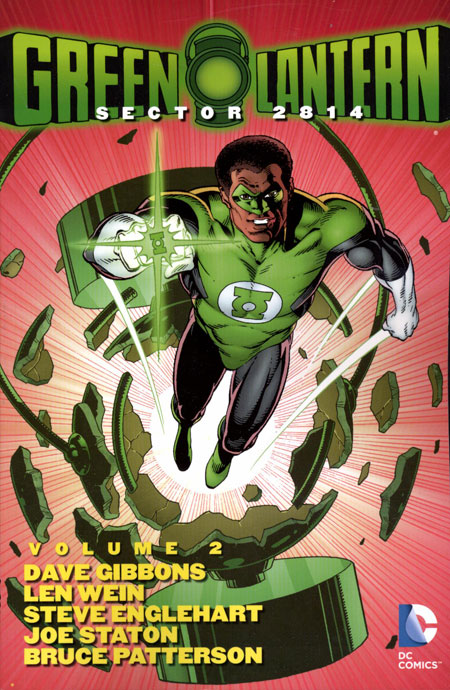
Review- GREEN LANTERN: SECTOR 2814 VOL. 2


GREEN LANTERN: SECTOR 2814 VOL. 2 (DC, First Printing, 2013; Softcover)

Collects Green Lantern #182, 183, 185-193 (main stories only) (cover dates November, 1984- October, 1985)

Writer: Len Wein (#182, 183, 185, 186), Paul Kupperberg (#187), and Steve Englehart (#188-193)

Artists: Dave Gibbons (Penciler, #182, 183, 185, 186), Bill Willingham (Penciler, #187), and Joe Staton (#188-193) with Inking by Mark Farmer, Mike DeCarlo, Rich Rankin, and Bruce Patterson


1984 and 1985 are “my” golden age of comics. I turned 11 and 12 in those years and many of my fondest comic memories come from that time. I was a Marvelite back then and I wouldn't have been caught dead reading anything from the Distinguished Competition. Everyone, and by everyone I mean my two comic reading friends and I, knew that DC sucked. More fool me. This is every bit as good as anything that Marvel was producing during this time period.


Indeed, Marvel alumni Len Wein and Steve Englehart capably handle this long running story of Hal Jordan quitting the Green Lantern Corps and him wrestling with his new life as a civilian while the new Green Lantern, John Stewart, learns the ropes. Stewart is from Detroit, which is awesome because no Marvel superhero was from Detroit back in 1984-85. I would have loved that as a kid.

Dave Gibbons' brilliant art is replicated as closely as possible by his replacement art team, Joe Staton and Bruce Patterson. Only my brand loyalty of the day kept me away from this comic. In all honesty I could barely afford the comics that I read at that time, so it's probably for the best that I was unwilling to read anything else.


My only gripe is the awful resolution to the Predator nemesis. Seriously? This is hackneyed, stoned '70s-style plot twisting at it's worst. I expected better from Englehart. He picks up and carries on well enough afterward, so I am looking forward to finally reading the third and final volume in this line of trades.
Junk Food For Thought rating: 4.5 out of 5.

The OCD zone- #184 was omitted because it was a reprint of Issue 59. The back-up stories are collected in a separate line of trades. DC's collected editions department has never made much sense to me.

Linework and Color restoration: The linework is excellent. At first glance it appears that some lines are dropped but a closer inspection against the original comic books reveals that what often appears to be thicker lines is really a gnashing of the plates and that there were thinner lines.

While the original color palette is faithfully maintained across the three issues that I did comparisons with it is the gradient shades used to soften the blends that stick out to my eye. Is it that big of a deal? The color blend is correct, only the method DC used at this time is not authentic to the era. The gradients give an airbrushed appearance to the edge of the blend, whereas when these are recolored “by hand” on a computer you get more authentic looking blends. Your OCD mileage may vary, I just list this (and in all honesty do this blog) to inform fellow fans on the good, the bad, and the ugly of collected editions.

Paper stock: Bright white glossy stock. Not optimal for material with flat coloring but I prefer it to the cheap paper which DC used to pass off on books of vintage material. They have since phased this paper out.

Binding: Perfect bound trade paperback.

Cardstock cover notes: Laminated cardstock cover. 

Saturday, October 29, 2016

Review- THE GREEN LANTERN OMNIBUS VOL. 2


THE GREEN LANTERN OMNIBUS VOL. 2 (DC, First Printing, 2011; Hardcover)

Collects Green Lantern #22-45 (cover dates July, 1963- June, 1966)

Writers: Gardner Fox and John Broome

Artists: Gil Kane with Inking by Murphy Anderson, Frank Giacoia, Joe Giella, and Sid Greene


Comic books are a wonderful escape from reality. It doesn't get any more escapist than the absolute good versus evil, white hat versus black hat mentality of Silver Age DC. DC were behind the times. Cross town rivals Marvel Comics were steeped in the zeitgeist, reflecting the changes of the day with their more sophisticated output.


The stories are formulaic and often predictable, but this is said from my armchair fifty years later. Audiences are more sophisticated today, for better and often worse. The artwork is the real draw here though. Gil Kane is a god. His artwork matures here, becoming more refined with each passing month, until he reaches his true voice that fans of his Marvel Comics work know and love. I will go as far as saying that no one except for Kirby was doing it as good as Gil Kane in 1966. *Guards face from rocks and tomatoes*


I enjoyed every single issue in this book, but I will list the ones that really grabbed me. I loved the battle with The Shark in #24. I loved the fight that he and Green Lantern had in the Wein/Gibbons run in the 1980s, and it was great to read his first appearance and his rematch with Green Lantern in #28. We see Gil Kane break the fourth wall in issue 29 for no real reason. Stan Lee and Jack Kirby did this over at Marvel a handful of times, so we'll just chalk it up to goofy Silver Age fun and move along.


#35's battle with The Golden Mask was a blast to read. Kane's action sequences really moved by this point. Folks like to throw words like dynamic around to describe Jack Kirby's artwork during this time. Kane was one of Kirby's few peers in 1966, and dare I say that he even gave the King a run for his money. Kane of course lacked Kirby's wild imagination, but for bone-crushing action Kane is right on the money.

Not everything here is timeless fun. Overly sensitive readers will find the portrayal of Hal Jordan/ Green Lantern's friend and confidant, Thomas Kalmaku (or Pieface as he is called) to be, shall we say...not as culturally sensitive as he is portrayed today. It's not a horribly racist caricature, but calling “his Eskimo friend” Pieface isn't something that would fly today.


Aside from that, this is brilliant stuff that was just what the doctor ordered for me. I welcomed the escape from reality that this book provided. DC is going to be reissuing this book as well as the first Omnibus in a hernia-inducing single volume titled Green Lantern: The Silver Age Omnibus Vol. 1, so if you missed out on this one or hate the tight binding (see The OCD zone for more information) on this book I strongly recommend that you grab it. I'm done with endless double dips and upgrades, so I'm sticking with this glued abomination.
Junk Food For Thought rating: 5 out of 5.

The OCD zone- DC's earliest entries into the Omnibus market were filled with missteps. To be fair, so were Marvel's. DC has since rectified the complaints in binding that I have below, so please understand that the complaints are about THIS BOOK, not about their Omnibus program as it currently stands, which is fine aside from not remastering their material.

Linework and Color restoration: The linework is excellent, as DC took very good care of their film. The color palette, while faithfully maintained here, is plagued by awful gradient blends instead of the more abrupt blends found in the original comics. If DC recolored their comics “by hand” on computer they could have rectified this.

Paper stock: Thick matte coated stock. I like the paper used in this book a lot.

Binding: Rage inducing glued mousetrap binding. It is so tight that this book should be kept away from small children. I wouldn't let my son near this book alone because it is a two fisted read. If you let it go it shuts fast. SNAP! He could break his finger or hand that way. This is some serious glue though. This book will never fall apart.


This book inspired me to make a video many moons ago. Bleeding Cool posted it, and it is the reason that many people discovered this here blog. I don't take myself too seriously, but this video is pretty bad. It makes me laugh.

Front cover. You can barely see it but Green Lanrern's power battery is stamped onto the front cover. DC's cheap feeling boards make me a sad panda.


Dustjacket and Hardback cover notes: DC's matte boards feel so cheap. No foil stamping, nothing. The dustjacket has a thick lamination. 

Thursday, March 31, 2016

Review- GREEN LANTERN: SECTOR 2814 VOL. 1


GREEN LANTERN: SECTOR 2814 VOL. 1 (DC, First Printing, 2012; Softcover)

Collects Green Lantern #172-176, 178-181 (cover dates January- October, 1984)

Writer: Len Wein
Artists: Dave Gibbons with Inking by Dick Giordano and Mike Decarlo


Sometimes you discover a run of comic books that are so good that you feel stupid for not having known that it even existed before. This is one such run of comics. The thing that I have come to terms with is that even after decades of reading comics and consuming them at an unhealthy rate that there remains untold treasures in the wings. I perceive this as a good thing, as the sky is the limit for the greatness out there just waiting to be discovered.

Len Wein is a writing powerhouse, able to juggle multiple plotlines at once while moving the main story forward. His insistence on using the term “ring-slinger” annoys me in the same manner as when he used the term “web-slinger” when he wrote Spider-Man. I don't know why, but the phrase annoys me and sticks out like a sore thumb among his otherwise superb writing. It's like a stellar musician who intentionally hits one bum note over and over and over. Dave Gibbons is a great artist who would soon go on to draw some series that no one remembers. I think that it was called Watchmen.

Len Wein wraps up a lengthy arc where Green Lantern was assigned to outer space to protect the rest of the sector assigned to him by the Guardians Of The Universe, Sector 2814. Hal Jordan (aka Green Lantern) returns home after a year away to resume his life, particularly his love life with Carol Ferris, his boss at Ferris Aircraft. There are all sorts of things wrong with the scenario of dating your boss here in 2016, but for the sake of suspension of disbelief let us journey to the simpler days of 1983 and 1984 when these comics were originally published and enjoy them for what they are.


I really enjoyed Green Lantern's battle with the Javelin (#173 and 174), who uses yellow weapons against which our hero has no defense for. You see, due to an imperfection in the manufacturing process of his power ring, Green Lantern has no control over anything yellow. Yes, I realize that this makes no sense, but use your suspension of disbelief and dig it anyways, okay? His battle with The Shark (#175 and 176) was cooler still. I was a Marvelite in 1984 and wouldn't touch anything from the Distinguished Competition as an 11 year old kid. I am glad that I have gotten over that. My son, on the other hand, seems to have the recessive DC gene, preferring Batman and The Flash to anything in Marvel's stable of heroes.


One of the plotlines that Len Wein slowly unraveled here was Congressman Bloch's personal vendetta against Ferris Aircraft. Bloch goes as far as to hire a team of garishly costumed and ridiculously powered villains called the Demolition Team, who show up to destroy the financially beleaguered company. As Green Lantern gets set to spring into action, the Guardians call him to save an entire planet from exploding. He must then decide on keeping his vow to the Guardians and the entire Sector of space that he has sworn to protect or save the factory of the woman he loves. He chooses duty over love, saving the entire planet. When he returns he finds that a mysterious new hero(?), the Predator, has dealt with the Demolition Team, although not before they could destroy nearly everything. Carol Ferris reads Hal Jordan the riot act, forcing him into a corner. The result is him going back to the Guardians and quitting the Green Lantern Corps.

This was an incredibly satisfying read and I give it my highest recommendation.
Junk Food For Thought rating: 5 out of 5.

The OCD zone- The Green Lantern Corps back-up stories from #172 and 173 are omitted, which is a shame because they have Dave Gibbons artwork. The back-up stories from #179, 180, and 181 are also omitted. It would have been nice if they added them in the back of the book as a bonus.
Issue #177 was omitted from this collection because it was a reprint of #128, likely done due to a missed deadline at the time.
Linework and Color restoration: As with most DC collected editions, things are a mixed bag. DC's film was properly stored and archived, as evidenced by how clean all of the linework is in this book. If there are any linework dropouts I didn't catch them on the handful of issues which I did a comparison with.

The original.

The version found in this book.


Take for example #175, page 24, panel 4. While DC has made great efforts to faithfully maintain the original color palette, they miss things like this. The shadows from Green Lantern's body are completely gone from the reprinted version. #175 is rife with mistakes like this, and they are peppered throughout the entire book. This is a great read, and if you did not compare it to the original comics you wouldn't care less. I view collected editions as Blu-Rays. I want to see the material as it originally was, only on better paper and with better printing, so these errors bother me.

The film for Page 4 of #173 must have been lost, as there is a noticeable drop in the quality of the linework from the rest of the book. It looks like it was scanned from a printed comic. Think of what IDW did when they were butchering the Marvel G.I. Joe series, only no one can butcher restoration as bad as IDW did for that series. I am just using it as a point of reference.
Paper stock: Glossy coated stock. While glossy stock isn't optimal for flat coloring, I will gladly take this over the cheap paper DC usually passes off on folks in their collected editions of vintage material.
Binding: Perfect bound trade paperback.
Cardstock cover notes: Laminated cardstock cover. 
Saturday, June 20, 2015

Review- ALL STAR COMICS ARCHIVES VOL. 1


ALL STAR COMICS ARCHIVES VOL. 1 (DC, Second Printing, 2000; Hardcover)

Collects All Star Comics #3-6 (cover dates Winter, 1940- August/ September, 1941)

Writers: Gardner Fox with Charles Reisenstein and other, unidentified writers.
Artists: Everett E. Hibbard, Sheldon Moldoff, Bernard Baily, Creig Flessel, Howard Sherman, Ben Flinton, Martin Nodell, Howard Purcell, Hal Sharp, Cliff Young, Irwin Hasen, Stan Aschmeier, and other possibly unidentified art assistants.

The Justice Society Of America was the first superhero team in the history of comics. That alone makes this book historically significant and worth a read. In Don Thompson's Foreword he claims that this is the first time that superheroes ever met one another in comic books. This is false. Over at Timely's Marvel Mystery Comics the Human Torch met (and battled) the Sub-Mariner in #8 (cover date June, 1940, on the stands months before that). Thompson was a respected member of the original organized fandom in the early 1960s, back when comic book collecting was not considered a serious hobby and long before these characters entered mainstream and I respect him, but he is wrong. Crossovers as such existed in some of the earliest newspaper strips at the turn of the 20th century, going as far back as The Katzenjammer Kids.

Way to go, Flash, think of ways to put honest firemen out of work.

That aside, this is a fascinating read. For starters, the characters all meet up and then go their separate ways to uncover whatever case they are working on. The kids these days call them “comic jams”, where one creator hands it off to the next. Each character's creator and primary artist handles their respective strips, and then there is a resolution at the end where they all meet up and solve the case. This formula is repeated in all four issues collected here. What makes this interesting is that instead of the anthology format used in all comics of the day you have one 58 page long story.

Comparing unions to Nazis. Sheesh.

I like how the JSA has a clubhouse where they meet. The simplicity of the times was evident throughout these comics. While the fashions and architecture of the time were contemporary to readers when these issues were originally published they only add to the escapist pleasure of the stories for me. I also enjoy the slang peppered in casual conversation. When modern writers try to write period piece comic like this they always come off as fake because they lack the reference points that the writers who were active during this era had.


Hey kids! Pop a pill and get super powers...just watch out for the crash an hour later. Coming down is a drag.

I enjoyed The Spectre, The Sandman, and the Hawkman parts of the stories the most. Flash is more enjoyable here than he was in other books that I read. 


There is some great talent on this book. Sheldon Moldoff's Hawkman is stunning, even if he totally swiped tons from Alex Raymond's Flash Gordon strip. Gardner Fox manages to juggle all of the balls between the various creators of each character, and for the most part it works. #7 is the weakest issue in the book.


I have several more of the books in this lane aging to perfection in my backlog with no real timetable on reading them. I guess that I'll get to them when I get to them. It's not like another year or three is going to matter with comics that already over 70 years old.
Junk Food For Thought rating: 3.75 out of 5.

The OCD zone- I like DC Archives. Back when SUVs were getting to be the size of tanks automakers started touting the “garageability” of Ford Explorers. Here in the Omnibus age, where books exceed 1,000 pages and have even hit the 1,500 page mark, I enjoy the “readability” of a 270-odd page book.

Linework and Color restoration: While the color palette is faithfully maintained, the linework is pretty washed out. This was remastered in 1991 using Greg Theakston's Theakstonizing method, where old comics are chemically treated and the color is removed. From there some of the lines were redrawn by hand, and it is obvious how many lines were washed out with this technique. Credit where credit is due, this was the state of the art technique of the day and Theakston was the pioneer in comic book restoration.

Scan of the original comic.

...and the version from the Archive. Notice how blotchy the linework is in places and how washed out it is in others. 

I was impressed by how close the colors were. The blends were done prior to Photoshop, so they were done by hand and therefore lack the cheesy lazy airbrush gradients found in many later DC Archives.

Think of this as a state of the art VHS remaster from 1991. Play that same VHS on a modern television and you will see graininess and the inferior techniques in comparison to what can be found in Blu-Rays. It is unfair to criticize the VHS remastering using this criteria, and it is unfair to outright condemn the work done on this book using 2015 eyes. This was a very good restoration job for it's day. It's a damn shame that DC never ever ever revisits and remasters their material. This material could look so much better. DC could use the Marvel strategy and rerelease this in an Omnibus, using the new format upgrade to defer the restoration cost. DC would simply slap the old files into a new book, like they are going to do in the forthcoming Golden Age Batman Omnibus. Sad.

Paper stock: Wonderful creamy off-white matte coated stock. Perfect.

Binding: Smyth sewn binding, lays perfectly flat.

Dustjacket and Hardback cover notes: Laminated dustjacket. Casewrap has grainy faux leather feel with foil dye stamping. 

Saturday, May 16, 2015

Review- ALL STAR COMICS ARCHIVES VOL. 0


ALL STAR COMICS ARCHIVES VOL. 0 (DC, 2006; Hardcover)

Collects All Star Comics #1, 2 (cover dates Summer- Fall, 1940)

Writers: Gardner Fox, Jon. L. Blummer, Jerry Siegel, Al Sulman, Evelyn Gaines, Ken Fitch (as William Waugh), Bill Finger, and John B. Wentworth
Artists: Sheldon Moldoff, Chad Grothkopf, Jon. L. Blummer, Everett E. Hibbard, Bernard Baily, Joseph Sulman, William A. Smith, Martin Nodell, Creig Flessel, and Stan Aschmeier

This was a big 64-page anthology series featuring many different super-heroes. I am not sure which Earth this is supposed to be or how it does or does not fit into current continuity, I just know that I love Golden Age DC.


Hawkman is awesome, as he “uses weapons of the past to battle evils of the present”. Sheldon Moldoff is one of the finest Golden Age comic book artists. The original Sandman is of course fantastic, owing much to the Pulps of the 1930s in tone and delivery. Gary Concord, The Ultra-Man is little more than a Flash Gordon retread, who himself was a Buck Rogers retread done right. The original Flash just bores me. I have no idea why. I enjoy the Silver Age reboot but the original bores me so much that I have no interest in buying the Archives of that run. 

Horrid, horrid gradient shade cheesy airbrush coloring as far as the eye can see. 

My favorite is The Spectre. The Golden Age version is the best comic of it's day, and it was the lure of stories not collected in the Golden Age Spectre Archives that had me scoop these All Star Archives when DC was liquidating them a couple of years ago. Hour-Man and Red, White And Blue are all lovable products of their time that put a smile on my face. Golden Age Comics are something of an acquired taste. They wouldn't hold up to most modern readers beyond historical significance, at least from what I gather via online comic communities.


Uh...okay. I am open minded, but I am pretty sure that everyone can agree that this is kind of sick. 

These are all fun, silly escapist reads. At the end of the day that is all that I am looking for anymore. The real world and real life are depressing enough; I don't need that clogging up my escapist hobby.
Junk Food For Thought rating: 4 out of 5.

The OCD zone- This is one of the thinnest Archives, clocking in at 144 pages. This is because DC didn't include these issues when they launched this line 15 years earlier and fan demand caused them to add a Vol. 0 to the line, which is great.

Linework and Color restoration: Horrid gradient shades as far as the eye can see. This technique looks wrong for the era. I can't be overly harsh though, as viewing this 2006 restoration with 2015 eyes is unfair. Imagine a DVD purchased in 2006. It probably was fine at the time of purchase, and certainly on par or better with everything else that was remastered at that point in time. Fast forward to the Blu-Ray era, and it looks thin and dated with low resolution. The same can be said for remastering techniques in these books. Advances in scanning and coloring technology has allowed the books to look more authentic to the original publications, often surpassing the primitive printing techniques of the time and looking as close to the original art as possible.

I cannot tell if the linework or color palette are authentic to the original publications as I A) do not own the original comic books to compare and B) cannot find scans online to compare with this book.

Paper stock: I love the paper stock used in DC Archives of this vintage. It is a creamy, off-white matte coated stock and is perfect. Why DC has done an about face and uses glossy paper in modern day Archives is beyond me.

Binding: Smyth sewn binding, lays mostly flat.

Hardback cover notes: Faux leather casewrap with die foil stamping.