Showing posts with label Human Torch. Show all posts

Friday, February 2, 2018

Review- MARVEL MASTERWORKS: GOLDEN AGE ALL-WINNERS VOL. 4


MARVEL MASTERWORKS: GOLDEN AGE ALL-WINNERS VOL. 4 (Marvel, First Printing, 2011; Hardcover)

Collects All-Winners Comics #15-19, 21, Vol. 2 # 1 (cover dates Spring, 1945- August, 1948)

Writers: Bill Finger, Otto Binder, William Woolfolk, and other unidentified writers

Artists: Alex Schomburg (covers), Mort Lawrence, Art Seymour, Al Bellman, Vince Alascia, George Klein, Al Avison, Clem Weisbecker, Mike Sekowsky, Maurice Gutwirth, Syd Shores, Allen Bellman, Mort Leav, Carl Burgos, Al Gabriele, Bob Powell, Louis Ferstadt, Carl Pfeufer, and other unidentified artists


Superheroes weren't selling very well after World War II. With the wind taken out of their sales, these comics come off as also rans, plodding along with writing and artwork that was vastly inferior to the earlier issues in this series.


By the time that we reach #17 there is a massive uptick in quality. Gone are the rush jobs done by the second tier comic book journeymen of the day, in is the more refined artwork by the likes of Al Avison, George Klein, and others. The writing in that issue is also head and shoulders above the previous two collected in this volume. Issue 18 is even better than #17.


Unlike DC's Justice Society Of America over in All-Star Comics, the All Winners Squad didn't really work together as a team until #19. This issue aped the JSA formula so well that had they employed it earlier they might have saved the title. There was no #20, and #21 occurred because the title took over the numbering from another title. 

Don't worry, kids! Those gorillas which Bucky is gunning down turned out to be wearing bullet proof vests later...not that Bucky knew it at the time. No PETA in the 1940s.

This was a common practice back among magazine publishers then, as they had to pay to file a new magazine title with the Post Office. Ditching titles while keeping numbering was common through the 1960s. This makes the relaunched #1 in 1948 even more curious. Was it a last ditch effort to save the series? An oversight? We can only guess now, as nearly everyone who worked on these comics is dead and gone. Record keeping wasn't much of a consideration in the comic world back then.

The Human Torch gives The Gay Blade a what-for in 1948.

#21 sees the All Winners Squad battle Future Man, a menace from the year One Million AD. He gives the team a run for their money. The relaunched #1 from 1948 was the best issue out of all four volumes in this line of books. We finally get to see the Blonde Phantom! I would love to read more of her exploits. Alas, Marvel has mothballed all plans for this Golden Age line of Masterworks, citing the unwelcome combination of soft sales and high restoration costs. I hope that they reverse that decision one day, as there is a lot of material that deserves to be restored and rereleased.
Junk Food For Thought rating: 3.75 out of 5.


The OCD zone- This is the part where I go into tactile sensations and materials of physical media. Those with heart conditions, high blood pressure, or women who are pregnant should exit my blog at their earliest convenience, as their safety cannot be guaranteed beyond this point.

Linework and Color restoration: Think of the post-2007 Masterworks as definitive Blu-Ray editions, with painstakingly restored linework and a color palette that is 100% faithful to the source material. Those who claim that the colors miss the “artistic choice” of so- called Ben Day dots are nuts.

Paper stock: Thick semi-glossy coated stock.

Binding: Rounded book casing and Smyth sewn binding allow this book to lay completely flat in one hand as Godzilla intended.

Dustjacket and Hardback cover notes: Spot varnish on the dustjacket, faux leather casewrap with dye foil stamping.

Sunday, August 24, 2014

Review- MARVEL MASTERWORKS: GOLDEN AGE CAPTAIN AMERICA VOL. 6


MARVEL MASTERWORKS: GOLDEN AGE CAPTAIN AMERICA VOL. 6 (Marvel, 2012; Hardcover)

Collects Captain America Comics Nos. 21-24 (cover dates December, 1942- March, 1943)

Writers: Stan Lee and other unidentified writers

Artists: Syd Shores, Vince Alascia, George Klein, Mike Sekowsky, Pierce Rice, Don Rico, Ed Winiarski, Ernie Hart, Harry Fisk, Edd Ashe, Al Avison, Al Gabriele, Bob Oksner, Guy Blythe, and other unidentified art assitants.

Golden Age comic books are fascinating to me. As stated in this book's introduction, creators were being drafted or were volunteering for the armed forces during this time, so multiple art assistants handled these strips assembly line style. Syd Shores keeps things tight and provides a consistent appearance throughout in spite of this. While the artwork isn't quite as good as the team of Simon and Kirby it has grown on me over the course of the post-S and K volumes. 


Golden Age comics were 52 page anthology series. Captain America was the headliner and got two or three stories per issue, with a Human Torch back-up story and recurring back-up strips The Secret Stamp and Dippy Diplomat as well as a two page text story. Those were included due to some ludicrous Post Office regulation from the late 19th century which stated that a periodical must have at least two pages of text to qualify for a specific mailing rate.

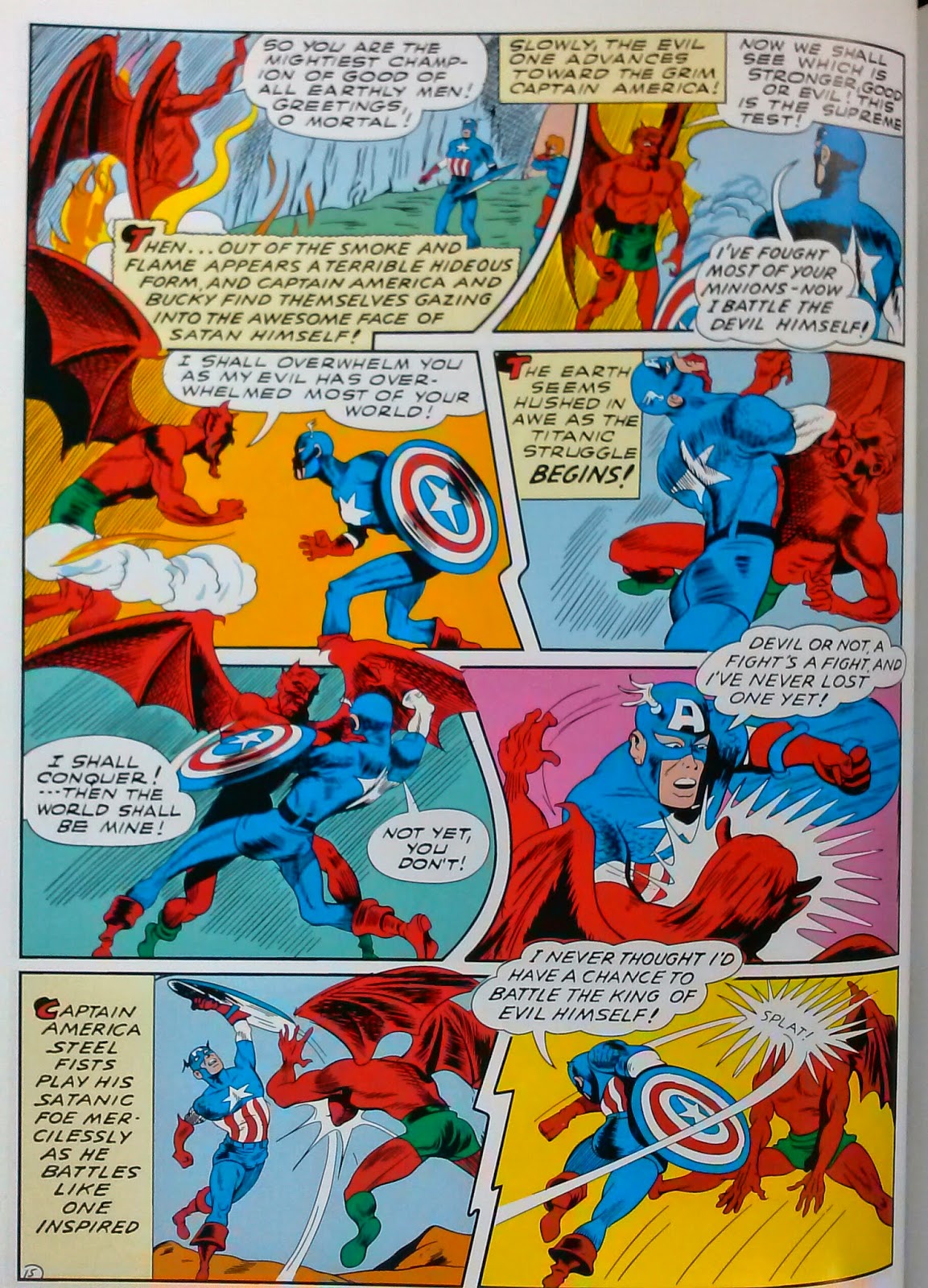
While the Nazis remain Captain America's foes, they are not his only foes this time out. Unlike the stories in Volume 5, Cap is back home fighting Fifth Columnists and the like. His enemies are mostly macabre-tinged, such as The Creeper, The Sorcerer, Satan (yes, the “real” Satan), Dr. Eternity, The Reaper, Count Varnis The Vampire, and some not-so-macabre villains, like The Turtle-Man, The Eel, Izan, and Prince Ba'Rahm, an “Oriental Mystic” who appears to be Arabic. I am sure that it was all Greek to rural folks in the 1940s.

I love Carl Burgo's work on the Human Torch. Every one who handled him after Burgos enlisted seemed to miss the point about this character. He was a fricking android and yet he is always portrayed as being knocked out by gas, so on and so forth. It is annoying and silly and the character has worn thin over the course of these Golden Age Masterworks.


Dippy Diplomat is a highly stylized strip with gags that are sometimes amusing but are often groan inducing. Comics were typically aimed at children but there was a large adult audience as well, particularly soldiers. Some of the gags in this strip were aimed squarely at adults. It is a pleasant enough read but could never carry a collection of it's own, which is why I am glad that Marvel takes the completist route for these anthology titles. Imagine how many gems are buried in those early issues of Action Comics and Detective Comics that we will never see.

The Secret Stamp, on the other hand, is geared for the kiddies. Roddy Colt is a newspaper boy who sells War Bonds while peddling newspapers. It is one of those quaint reads that is more of a historical curiosity than it is a compelling read.

Like all Golden Age comics, there is a sort of almost casual racism throughout. While modern politically correct comic fans are uber-sensitive, I can accept what the mores of society were during this time. Your mileage may vary.


Marvel seems to have mothballed Golden Age reprints, since not one collection of material was or is scheduled to be released this year. Contrary to what the Disney conspiracy theorists think, I believe that this has less to do with political correctness at the corporate level and more to do with lack of enthusiasm on the consumer end. I know that I did my part and bought them all. I hope that we see more of these someday but I won't be holding my breath.
Junk Food For Thought rating: 4 out of 5.

http://www.instocktrades.com/TP/Marvel/MMW-GOLDEN-AGE-CAPTAIN-AMERICA-HC-VOL-06/JUL120634

http://www.instocktrades.com/TP/Marvel/MMW-GOLDEN-AGE-CAPTAIN-AMERICA-HC-VOL-06-DM-VAR-ED/JUL120635

The OCD zone- Marvel Masterworks are my poison of choice. For Masterworks of this book's vintage, rest assured that this is the definitive Blu-Ray edition of this material.

DVD-style Extras included in this book: Introduction by Will Murray. (5 pages)
Cover to the squarebound 1942 all-reprint Canadian Captain America “Annual”. (1 page)

Linework and color restoration: 5 out of 5. Think of the post-2007 Masterworks as definitive Blu-Ray editions, with painstakingly restored linework and a color palette that is 100% faithful to the source material.

Paper rating: 5 out of 5. Thick coated semi-glossy stock that has that sweet, sweet smell that all Chinese manufactured books have. I theorize that this delectable aroma is caused by the toxic stew of broken asbestos tiles, lead paint chips, heavy metal industrial waste, and mercury from recalled thermometers combined with the blood, sweat, and tears of the Chinese children working the sweatshop printing presses. The frosting on this delicious cake scent is the paper which is likely sourced from virgin Amazon rainforests.

Binding rating: 5 out of 5. Rounded book casing and Smyth sewn binding (six stitches per signature) allow this book to lay completely flat in one hand as Godzilla intended.

Saturday, May 3, 2014

Review- THE THING: LIBERTY LEGION


THE THING: LIBERTY LEGION (Marvel, 2011; Hardcover)

Collects Invaders Nos. 5, 6 Marvel Premiere Nos. 29, 30, Fantastic Four Annual No. 11, Marvel Two-In-One Annual No. 1, and Marvel Two-In-One No. 20 (cover dates March- October, 1976)

Writer: Roy Thomas

Artists: Pencilers- John Buscema, Don Heck, Sal Buscema, Frank Robbins, Rich Buckler, and Dick Ayers; Inkers- Vince Colletta, Sam Grainger, Jim Mooney, George Roussos, and John Tartaglione

The year was 1976, and America's Bicentennial was all the rage. While I was a mere 3 years old at the time, the reverberations of this celebration were felt for years, with all of the leftover Spirit of '76 flags, welcome doormats, coffee mugs, and other paraphernalia. With the apparent success of The Invaders, Roy Thomas was all set to push his Golden Age fetish with yet another team of superheroes set during the 1940s, this batch from the Timely Comics era of Marvel.


Using a somewhat ingenious scenario to unite these seven misfits, Roy Thomas brought in characters which the average comic fan of the day would have no idea who they were. The only reason that I knew who any of them were is because I own all of the Golden Age Marvel Masterworks, and even those don't contain all of the stories referred to here. The Red Skull manages to hypnotize The Invaders (Captain America, The Human Torch, The Sub-Mariner, and the Torch's kid sidekick, Toro) except for Bucky Barnes. Barnes then does a ham-fisted invasion of a radio station to call other heroes for help. Scenarios like this are corny and overwritten, but Thomas does them to move things along while demonstrating the heroes' powers with their misunderstanding fights/ hey, let's team up outcomes. Answering Bucky's call are the Whizzer, Jack Frost, the Blue Diamond, Red Raven, Miss America, The Patriot, and The Thin Man. They are dubbed the Liberty Legion and of course free The Invaders.


Comic fans, myself included, bemoan the crossover. Such blatant cash grabs...such gimmicky marketing...if only comics could go back to the good ol' days! You mean like the good ol's days of early 1976, when rascally Roy Thomas made you buy Invaders #5, Marvel Premiere #29, Invaders #6, and then Marvel Premiere #30 in order to get the complete story? Or howsabout how, in an apparent act of desperation to get his beloved Golden Age heroes into their very own ongoing series, they became the focal point of a crossover which began in Fantastic Four Annual #11, continued in Marvel Two-In-One Annual #1, and finally ended in Marvel Two-In-One #20. Yes, Marvel has been suckering us all into buying comics that we didn't really want to buy for longer than any of us want to admit.

Occasionally clunky dialogue and some overwriting aside, these are all fun reads. The artwork is solid. Just look at that list of artists above, it's a veritable who's who of Bronze Age journeymen. In the second crossover (or “arc” as the kids call them) the Liberty Legion take a backseat to The Thing and the rest of the Fantastic Four. Indeed, the team are not the main focus for the majority of the book. Marvel Two-In-One Annual #1 features a young Johnny Romita in the New York of 1942, one of a billion Roy Thomas winks and nods (or “Easter eggs” as the hipsters say) peppered throughout these comic books. Roy Thomas was one of the original generation of comic book fans who came to write comics. His reverence for the medium is apparent. What many folks thought of as disposable entertainment Thomas saw as an important artform.


Praise be to Marvel for releasing such a left field, odd duck collection. No one would have ever asked them to make it, but I was only too happy to buy it. I am not sure what that says about me, but I am certain that someday the pharmaceutical industry will make a pill to cure me of it. Until then, MAKE MINE MARVEL!*
*Sentiment does not apply to most modern Marvel Comics.
Junk Food For Thought rating: 3.75 out of 5.

The OCD zone- The late, lamented Marvel Premiere Classic Hardcovers were a sort of junior Masterworks line. While they weren't quite the “Blu-Ray” version of these issues like you would see in a Marvel Masterwork, they are still excellent.

DVD-style Extras included in this book: Give Me Liberty- Or Give Me Legion text pages by Roy Thomas from Marvel Premiere #29 and 30 (2 pages).

Linework and Color restoration rating: 3 out of 5. This rating is based on an average. Some of these issues are a muddy, pixelated mess (Invaders #6) while others are perfectly fine, serviceable restorations (Marvel Two-In-One #20). The original color palette is maintained for the most part with only a minor deviation here or there.

Paper rating: 5 out of 5. Sweet smelling toxic ink Chinese made virgin Amazon rainforest tree-sourced coated stock paper with a slight sheen.

Binding rating: 5 out of 5. Smyth sewn binding, 6 stitches per signature. The book lays 90-95% flat. The book block doesn't have much room to flex to lay perfectly because the squared casing.

http://www.instocktrades.com/TP/Marvel/THING-PREM-HC-LIBERTY-LEGION/JAN110826


Tuesday, July 12, 2011

Reviews: Creepy Archives Vol. 7 and Marvel Masterworks Golden Age Human Torch Vol. 3


CREEPY ARCHIVES VOL. 7 (Dark Horse, 2010; Hardcover)

Collects Creepy Nos. 33-36 (cover dates June- November, 1970)

Yet another beautifully produced Dark Horse Archive, with the same high quality paper, restoration, and sewn binding that I have come to expect from the line. Most of the stories during this era of the title were okay but not very memorable. There were several that deserve to mentioned.

Issue 33's Blue Mum Day is wonderful mummy story by (writer) Michael Rosen and EC alumni (artist) Reed Crandall, a master of the art form, particularly the Horror genre.

Issue 34's The Swamp In Hell (writer-Don Vaughn/ Artist-Al Hewetson) has a very Twilight Zone feel to it. It's a story about a blind man and a swamp monster. Ando!, by writer Michael Rosen, boasts excellent, vibrant artwork by Golden Age great Syd Shores. His pencils have nice texture and shading and are a treat to look at.

The pair collaborate again on Issue 35's Army of the Walking Dead, a World War II zombie story that sees the Nazis experimenting with an army of the undead. The zombies bear a resemblance to Eddie from the Iron Maiden albums covers, and this story pre-dates Eddie by at least a decade. Syd Shores also provided pencils to this issue's It's Grim, this time with writer Al Hewetson, in a tale about taxidermy gone wrong.

Creepy began to diversify it's content into science fiction and sword and sorcery, and Godslayer fell into the latter category. Written and drawn by Bill Stillwell, this is another delight to the eyes. I'd even go as far as to say that Stillwell was among the finest artists of the era. Your mileage may vary.

The gem of Issue 35 would have to be Gunsmoke Charly, another Twilight Zone riff about a gunslinger who wants to be the fastest gun in the West. He makes a deal with the devil, and you can probably guess how that turned out for him.

The final story in the book also happens to be Artist Richard Corben's first for the Warren Magazines. Frozen Beauty is another age old retread about vanity and beauty, but has nice Corben artwork that keeps it from wallowing in mediocrity.

So yeah, while this book is not the golden age of the Warren Magazines, it is definitely worth taking a look at. There is much gold in this sand.


MARVEL MASTERWORKS: GOLDEN AGE HUMAN TORCH VOL. 3 (Marvel, 2010; Hardcover)

Collects The Human Torch Nos. 9-12 (cover dates Fall, 1942- Summer, 1943)

Either the writing is getting more sophisticated and enjoyable in these Golden Age comics, or I have simply read so many of them that my brain has turned to mush. I think that the lack of continuity is funny, like how the Human Torch gets knocked out by gas when he is an android. He is clearly established as an android in his earlier appearances in Marvel Comics in 1939. The Sub-Mariner (a regular back-up feature in this title) no longer has the tiny wings on his feet or the ability to fly. There is also no mention of, or even a visit to, Atlantis, which is odd since Namor was shown to be a prince in his own title. I am guessing that the primary reasons are that Carl Burgos and Bill Everett were in the army at this time, and that Carl Pfeufer and company did whatever they wanted to with the characters.

The production values are all top notch as usual. Nice paper, sewn binding, excellent restoration...heck, it even smells good. I seriously stop and whiff these books every so often. I know, I have problems.

Sunday, March 27, 2011

Reviews: Vampire Tales Vol. 1; Marvel Masterworks- The Human Torch Vol. 1; Soundgarden- Live On I5

One could argue that we are currently living in the Golden Age of comic books. No, I am not saying that sales are anywhere near where they were in the halcyon days of the 1930s and 1940s, but in terms of the sheer depth and breadth of titles from all eras being readily available to all readers. Collections range from bargain priced crash courses into character history (i.e Essentials, Showcase Presents, Chronicles TPBs) to comprehensive high end collections (i.e. Masterworks, Archives, Omnibus editions, etc.) and all price points in between. Flip through a copy of Diamond Previews and see for yourself. On any given month, there are collections available from every decade (the 1930s- present day collections) in all shapes and sizes. Some are very affordable and go to the level of being...not as affordable. As a fan and reader foremost, I feel like I can stand at the crossroads and cherry pick comics from every decade and every genre, and bask in the warmth of the promise of future treasures from all eras being unearthed. When I was a collector starting out in the 1980s, it was current comic books and cheap-o '70s or lesser condition '60s comics. That was it. I couldn't even dream of affording, let alone reading, comic books from the '30s-50s. A fan starting out today could literally become an expert on the medium with far less investment.


VAMPIRE TALES VOL. 1 (Marvel, 2010; softcover)

Collects Vampire Tales Nos. 1-3 (cover dates 1973- February, 1974)

File this one under "dreams come true". I have long wanted to see this series collected in ANY format. It was released in Marvel's new "Graphic Novel" format, which is a bit smaller and narrower than a standard comic book. It's not my preferred format, but it's better than nothing. The cover image is a poor choice, especially when you consider how impressive each issue's painted cover is. Any one of them would have helped to make this a more attractive package.

All of the original text pieces are included, and the covers are presented in full color. The original issues were black and white. There are some reprints of Atlas Era Horror material as back up features, and they are included here as they were in the original issues of Vampire Tales.

I had Issue 3 back in the '80s. Morbius the Living Vampire has been a favorite of mine since I first encountered him in Peter Parker, the Spectacular Spider-Man #38 back in 1978. My Mom bought me that one evening when we went grocery shopping at Farmer Jack. Morbius was originally the star feature of this title until Issue 3, when all of the focus seemed to shift to Satana, the Devil's Daughter. I love '70s Horror comics, with their faux-Satanic, Hollywood-tinged evil. It's so much more interesting than "real" evil or Satanic stuff, which is just stupid.

One of the things that I enjoy about these '70s Marvel Horror magazines are the way that they push the envelope. Freed of the Comics Code Authority, they can do pretty much whatever they want to. Drug references, violence, bloodshed...they're all here. I have a double standard: I love this stuff in comics, but not in mainstream Marvel Comics. When it comes to Spider-Man, Captain America, etc., I want things to be age appropriate. When it's Horror or non-Marvel stuff, then the sky's the limit as far as I am concerned. Again, it's a total double standard and I freely admit it, but I think that it boils down to the fact that Spider-Man, Iron Man, Hulk, etc., are all marketed to children, whereas Morbius the Living Vampire is not.

I am still keeping my fingers crossed for a comprehensive Morbius Hardcover series down the road. I'd love to see a Masterwork or an Omnibus. Hey, a guy can dream, right? Just like I used to dream about seeing this series reprinted...


MARVEL MASTERWORKS: THE HUMAN TORCH VOL. 1 (Marvel, 2006; Hardcover)

Collects selections from Strange Tales Nos. 101-117 and Strange Tales Annual No. 2 (cover dates October, 1962- February, 1964)

I picked this up at the Motor City Comic Con last May for $15 in mint condition, still sealed in the original factory shrinkwrap. I mean, the cover states that it's by Stan Lee and Jack Kirby. It's got to be gold, right? Wrong! Stan Lee only plots and edits the bulk of these issues and turns over the scripting duties to brother Larry Lieber and other third stringers. Jack Kirby only does the occasional pencil layouts or inking, and Dick Ayers does most of the artwork. Ayers is my least favorite artist from this era of Marvel. His artwork leaves me cold. I forgot just how unlikable the Human Torch was back then. Come to think of it, I always considered him to the weak link of the Fantastic Four, being too hot headed and rash for my tastes.

The later issues in the book step up in quality when Stan and Jack handle the book themselves. Lots of fun stuff occurs, like the Torch fighting the Sandman, the Puppet Master, and  the Acrobat, who poses as Captain America in a story that came out before Marvel reintroduced Cap. After enjoying the last few issues in the book, I am on the fence about Volume 2.

This book was something of a shock to the system. I have become quite spoiled by the quality of Masterworks over the last few years, and forgot about some of the speed bumps that the line had along the way. This book is from the era where they got the coloring, linework, and paper down pat, but suffers from glued binding. Not just glued binding, but super tight mousetrap style binding. I'm serious, this is a two-fisted read. If you let go for one second, SNAP!, the book closes just like a mousetrap. Glued binding on hardcovers is the devil, and this was a trip back to the bad old days.


Soundgarden/ Live On I5 (A&M, 2011)

I have fond memories of the Soundgarden concert I attended in November of 1996, and I jumped at the chance to buy a live album recorded a month after that show. The setlist is a bit different than the one that I saw, and the CD doesn't sound anywhere near as powerful as the concert did. That's the drawback of live albums. While they are important documents of a specific era of any given band, it can't replicate the sensory experience that is a live concert.

The sound quality and performances are both excellent, and I wish that they would have released this years ago. Oh well, better late than never.