Showing posts with label Harvey Pekar. Show all posts

Friday, May 4, 2018

Review- OUR CANCER YEAR


OUR CANCER YEAR (Running Press, Seventh Printing, 1994; Softcover)

Original Graphic Novel

Writers: Joyce Brabner and Harvey Pekar

Artist: Frank Stack


Our Cancer Year is another in a long line of Harvey Pekar's autobiographical line of comics. While it is not branded as an American Splendor comic it is very similar in feel and tone. This time he co-writes with his wife Joyce Brabner. It's more of a shared vision than your standard Harvey Pekar story starring Our Man.

Harvey is something of a worry wart who also tends to put things off. He notices a lump on his left groin but ignores it. It starts growing and after his wife continually nags him to get it checked out, he does. Harvey is diagnosed with lymphoma. While they are able to remove it all he still has to go through chemotherapy and radiation treatment. It is during this time that things get really rough for him. Harvey has always been very self-reliant, and to put himself at the mercy of others is a humbling experience. I can't imagine anyone taking something like that well. He gets really down and almost throws in the towel a number of times. Joyce tries to keep him going but the situation becomes almost as rough on her as it is for Harvey, albeit it in a different way.


This story took place in 1990-91, with the events leading up to and including Operation Desert Storm being a secondary story as well as Harvey dealing with Joyce and her overseas volunteer work. Another facet of the story is the introduction and implementation of computers into daily life. Joyce uses a very primitive Internet to communicate with her friends overseas. Harvey wants nothing to do with it until he realizes he has to use it to communicate with her while she's away on her volunteer work.


Harvey is stubborn and keeps trying to work even though he is still on the mend. When he finally does return to work he finds that his job has been filled and that he now has to learn how to use computers. I was in my late teens when the events in this book occurred. I remember the invasion of Kuwait and the beginning of Operation Desert Storm. I also remember the primitive high school computers with the two tone green screen and 5 inch floppy disk drives. Computers were pretty useless and uninteresting back then. Harvey Pekar and I both discovered in the coming years that the world was about to change forever.


Our Cancer Year is a testament to stubbornness and overcoming impossible odds. Pekar continues to inspire many of us, even when he isn't trying to.
Junk Food For Thought rating: 4.25 out of 5.

The OCD zone- This is the part where I go into tactile sensations and materials of physical media. Those with heart conditions, high blood pressure, or women who are pregnant should exit my blog at their earliest convenience, as their safety cannot be guaranteed beyond this point.

This book is wider than your standard size modern day trade paperback.

Paper stock: Fair weight matte stock.

Binding: Perfect bound trade paperback.

Cardstock cover notes: Laminated cardstock cover.

Tuesday, January 23, 2018

Review- THE NEW AMERICAN SPLENDOR ANTHOLOGY


THE NEW AMERICAN SPLENDOR ANTHOLOGY (Ballantine Books, 2010 Printing- original compilation published in 1991; Softcover)

Collects selections from American Splendor #3-15, Flamed-Out Funnies #1, Comix Book #4, Snarf #6, Strip AIDS U.S.A, Aargh!, Ed The Happy Clown, Real Stuff #1, Colin Upton's Big Thing #1, and three previously unpublished stories (cover dates 1978-1991)

Writer: Harvey Pekar

Artists: Drew Friedman, Robert Crumb, Frank Stack, Val Mayerik, James Sherman, Gerry Shamray, Joe Zabel, Gary Dumm, Rebecca Huntington, Ed Wesolowski, Paul Mavrides, Alison Bechdal, Laura Darnell Dumm, William Fogg, Alan Moore, Carole “Paczki” Sobocinski, Spain Rodriguez, Mark “M. A.” Zingarelli, Bill Knapp, Kevin Brown, Greg Budgett, J. R. Statts, Willy Murphy, Robert Armstrong, L. B. Armstrong, Chester Brown, Jim Woodring, and Colin Upton


Some folks turn to alcohol or drugs when things go south. I turn to reading a Harvey Pekar book. It was during a long, brutally cold snap earlier this month when I decided to bask in Pekar's philosophies on life. Pekar seldom gives you the answers, but his work seems to point the reader in the right direction. Indeed, Pekar's self doubts keep him from finding the answers himself.

Pekar gives you real slices of life stories from the man on the street angle. There aren't too many regular Joe, working man on the street types anymore. Everyone acts like they are too good for everything, too smart, or too rich. The reality of the situation is that those folks are acting the fool, and Pekar is in on the joke.


I checked out the American Splendor movie from 2003 from the library just after I finished this book, and I'm glad that I did. I like to read the source material before seeing a film. Half of this book wound up in the film. Toby and the Revenge Of The Nerds segment, Pekar's numerous visits on The David Letterman Show, and a few other small bits that are reprinted here come to life in that film. The movie is of course fantastic.


There are a lot of one page gags and asides that Pekar did for other comics that do not feature Our Man (the name of Harvey Pekar in comic book form). Most of them are forgettable. This is a less personal take on Our Man than in the other Pekar books that I've read so far but it is still essential reading.


The artwork is a mixed bag, and most of it is not my cup of tea. I really enjoyed Drew Friedman's artwork a lot, and there is a helping of Crumb which doesn't hurt things either.

I'll continue my Pekar marathon whenever I hit a bump in life. Stay tuned.
Junk Food For Thought rating: 4 out of 5.

The OCD zone- This is the part where I go into tactile sensations of physical media. Those with heart conditions, high blood pressure, or women who are pregnant should exit my blog at their earliest convenience, as their safety cannot be guaranteed beyond this point.

This book is wider than a standard modern day trade paperback.

Linework restoration: I have no original copies nor any source material to compare, so no comment. One of the stories looks murky, like it was sourced from a printed copy rather than film/photostats like the rest of the material. It's night and day.

Paper stock: Matte stock with no coating.

Binding: Perfect bound trade paperback.

Cardstock cover notes: Laminated cardstock cover. 

Tuesday, October 24, 2017

Review- STUDS TERKEL'S WORKING


STUDS TERKEL'S WORKING (The New Press, First Printing, 2009; Softcover)

Original Graphic Novel

Writers: Studs Terkel, adapted by Harvey Pekar with additional adaptations by Sharon Rudhal, Peter Kuper, Sabrina Jones, Lance Tooks, Danny Fingeroth, and Gary Dumm

Artists: Sharon Rudhal, Anne Timmons, Dylan A.T. Miner, Peter Kuper, Sabrina Jones, Joan Reilly, Peter Gullerud, Ryan Insana, Lance Tooks, Bob Hall, Terry LaBan, Pablo G. Callejo, Emily Nemens, Nick Thorkelson, and Gary Dumm

Studs Terkel's Working is a fascinating look at what people do for a living. Or more accurately, what we used to do for a living. The original novel was published in 1972, and the field of labor has changed dramatically in the past 45 years. That said, many of these jobs still exist, although the attitudes against people who are employed in these fields is much different than it was at the time that the original book was published.


For example, people once looked up to teachers and factory workers. Now they are frowned upon because of unions. In the decades since the original work was published, labor has become anti-people and more pro-company. Technology and our society as a whole has dehumanized us all, to the point where we are all cogs in machines pressed to produce. Every worker is more efficient than ever and yet is valued less than before by companies.

This book is based on interviews that were done with people in various professions. Mailman, teacher, farm worker, and even prostitutes. It is that tale, Hooker, that is the most riveting in the book. While nearly all of the tales mention the downfalls and changes within the profession, it is this one which is the most disturbing.


Pekar adapted 12 of the 28 short stories that comprise this graphic novel, so it is not a true Pekar book, but most of the stories are well done. I got a kick out of seeing 1980s Marvel veterans Danny Fingeroth and Bob Hall team up for a few stories here. Most of the people who worked on this book are unknown quantities to me.

Harvey Pekar is the everyman, and he is hands down the man for the job of putting the polish on these tales. Pekar is the type of guy who no longer exists. A guy who just wants to get by, with no delusions of grandeur about becoming a CEO or someone important. He gets what is really important about life, and that is regular people who do regular work.
Junk Food For Thought rating: 4 out of 5.

The OCD zone- Library books are fascinating science experiments in the workmanship of the materials used to make these books.
Paper stock: Matte uncoated stock.
Binding: Perfect bound trade paperback.
Cardstock cover notes: Cardstock has a matte coating and a 1/3 length fold over on the inside of the front and back covers, giving an added heft and durability to the cover.


Monday, August 21, 2017

Review- CLEVELAND


CLEVELAND (Z2, Second Printing, 2017; Hardcover)

Original Graphic Novel from 2012

Writer: Harvey Pekar

Artist: Joseph Remnant


Comic books are considered the ninth artform, which seems kind of low on the totem pole of art since they have the expressive capability of literature along with the visual impact of cinema. Not all comic books are art, nor do they need to be. I am admittedly of the “capes” set, meaning that superheroes are my first and primary interest. Over the years my tastes have expanded and I have dipped my toe into other waters while remaining loyal to my beloved superheroes.


Harvey Pekar comics are deceptive, as they often look crude and sloppy when compared to their more polished mainstream counterparts, but in terms of accomplishing and saying something they are art of the highest order. I have to be in a very specific frame of mind to read Pekar. I was going through a brutal divorce and a bitter custody battle throughout most of last year, and when life was at it's bleakest point a friend told me to check out Pekar. American Splendor was like a lifesaver thrown to me as I was drowning. I'll put it to you like this. I own over 1100 collected editions yet only have two bookshelves. The rest are all kept in acid free magazine boxes. I keep all of my Pekar books on the shelf in case I need one, the comic book equivalent of “break glass in case of emergency”.


Cleveland is Pekar's autobiography. He is from Cleveland and never left, nor did he ever want to. The first forty or so pages of this roughly 120 page book is Pekar setting the stage with the history of Cleveland peppered with his worldview. Pekar is the son of Polish immigrants and grew up poor. His views on poverty and race are to the point and pull no punches. He watched the city go down the tubes and come back in some ways while watching lots of problems get rearranged like so many deck chairs. Life is like that. There are no answers to some questions.

This was among Pekar's final projects and was published posthumously, adding to it's poignancy. Here we see a 70 year old Pekar musing about life and seemingly resigned to his fate. His bitterness has mostly subsided and he has taken a matter of fact stance on relationships. I haven't read all of his work, but this is the finest artwork that I have seen in any of his books thus far. Remnant's art perfectly suits the mood of the book.


There are times when I miss my 20s. I knew all of the answers, as young people tend to do. In my 30s I realized that not only did I not know the answers, I didn't even know the questions. In my 40s I have found that there aren't even questions. On a cosmic scale none of this matters. The beauty of Pekar is that he makes normal everyday existence seem of cosmic importance. I have several more Pekar books sitting on my bookshelf, sitting there like a fire extinguisher in case of personal emergency. As much as I love his material I am not in any rush to read them. They will be read when the universe deems it necessary. God bless Harvey Pekar.
Junk Food For Thought rating: 5 out of 5.

The OCD zone- This book is slightly smaller than your standard collected edition.
Paper stock: Uncoated stock.
Binding: Sewn binding, a bit stiff but no big deal since the book is small and light.
Hardback cover notes: Matte casewrap with a quarter binding wrapped around the spine. 

Thursday, April 14, 2016

Review- AMERICAN SPLENDOR


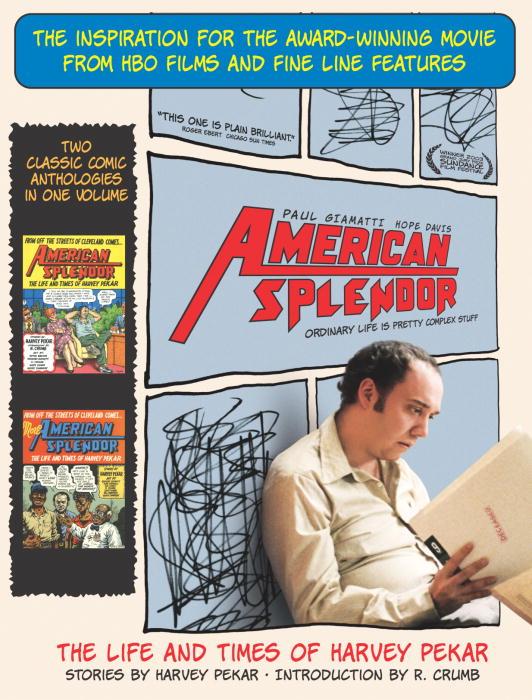
AMERICAN SPLENDOR (First Ballantine Books Printing, 2003; Softcover)

Collects selections from American Splendor #1-11 (cover dates May, 1976- 1986)

Writer: Harvey Pekar
Artists: Kevin Brown, Gregory Budgett, R. Crumb, Gary Dumm, Gerry Shamray, Sean Carroll, Sue Cavey, and Val Mayerik

I have been going through a rough patch in my personal life over the past few months. I won't go into the whats or whys or wherefores of it all, suffice it to say that life is a strange thing and that there are no guarantees. A friend of mine repeatedly urged me to check out the works of Harvey Pekar. He told me that his life mirrored mine at the moment and vice versa. I trust the opinion of this friend, as he turned me on to Bukowski and is an artist who has produced work which I hold in extremely high regard.


Harvey Pekar is the star and hero of his own strip, the autobiographical American Splendor. While I know nothing about underground comics (or comix, as the kids who are now grandparents called them at the time), I can appreciate how far ahead of it's time this comic was. I am confident in saying that Pekar invented an entirely new language for comic books. Nothing out there at that time read like this. It was so far ahead of it's time that it reads as contemporary with 2016 eyes. I read things in the here and now and also consider the work within the context in which it was published, and this holds up on both counts.

Pekar is a well-intentioned (if self-defeating) free thinker who is his own best friend and worst enemy in one. In that regard he is exactly like the rest of us, at least those of us who are humble and like the simple life. Like Pekar, I toil in a seemingly menial job but am content with the living that I have eked out because of it. I would rather have relative financial security and let my mind soar at work than be stuck doing something “important” which would yield only less happiness for me. My only ambition in this life is to be happy, or as close to happy as I can be within the context of my circumstances. Also like Pekar, I value truth and loyalty over flash and hype in people. Pekar cannot fathom why virtues are not more valuable than monetary success, and he's right. A great artist whose work brightens the world can be poor while someone who does things to screw people over gets rewarded financially. Don't both things add value to life? One adds cultural value, the other financial value to a company's bottom line. What does that say about us as a society when we view and reward the one which is worse for everyone more favorably?


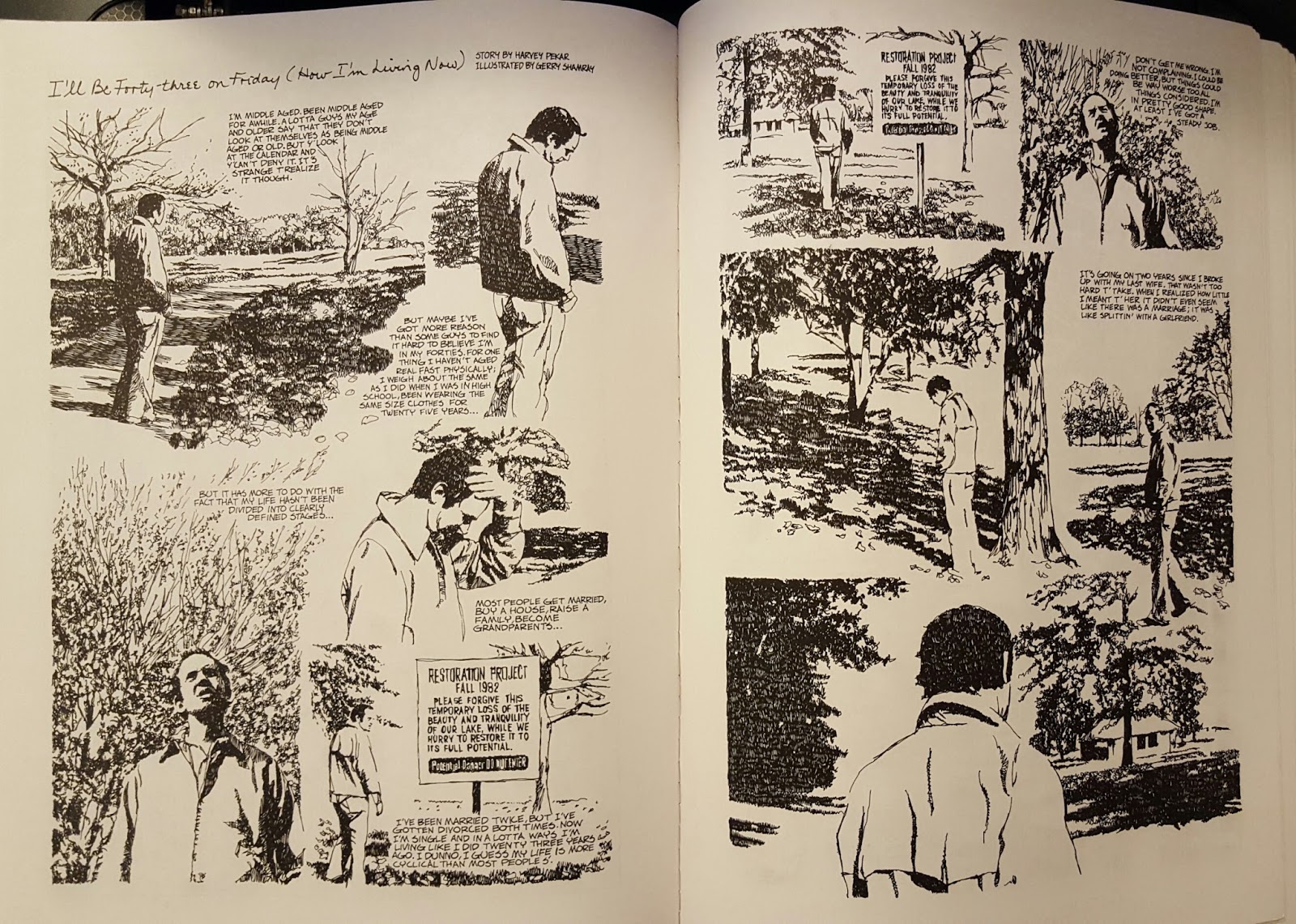
Pekar writes about ordinary life, which sounds boring on paper but in reality is the real heavy, kids. Waking To The Terror Of The New Day is profound. An Argument At Work is one of the many reasons that this book spoke to me. Leonard & Marie was touching. Stetson Shoes spoke to me for a reason I won't share here. I'll Be Forty-Three On Friday (How I'm Living Now) is the best story in the book. Pekar makes nothing seem like something important. Maybe it is because real life is important. Folks tend to sweep the little things under the rug when they should maybe stop and pay attention, because the little things become the moments that define us. At least that is the realization that I have come to over the past few months. The big picture versus the little picture. Focus on the one and you lose sight of them both.


Pekar touches on many themes such as race, socioeconomic circles, gentrification and integration and the effects thereof, and other truths. The lighter fare offsets the heaviness or preachiness of the weightier topics, resulting in a well-balanced slice of life.

The art is a mixed bag. While I am admittedly of the Adams/Kirby/Ditko/Steranko school of thought most of these cats carry the story forward well enough. A few of them are very good, with ideas far outside of the box of what comic books could look like during this time frame.

Middle age is a strange thing. I am no longer a young man ready to inherit the world, nor am I ready to give up on it. I'm not old enough to reap the rewards that old age brings. Middle age is like you're here, only here isn't necessarily what you once thought it would be, and even if you wanted it it may not be where you belong anyways. If there are answers to what life is, I certainly haven't found them yet. Harvey Pekar might have, though. He at least tries to point you in the right direction. Maybe further reading of his work will reveal the answer.
Junk Food For Thought rating: 5 out of 5.

The OCD zone- This is much wider than a standard trade paperback.
Linework restoration: I haven't done any comparison with the original comic books and therefore have no comment.
Paper stock: Thick uncoated stock.
Binding: Perfect bound trade paperback. It should be noted that this is a library copy and has been read countless times and has held strong.
Cardstock cover notes: Thick cardstock cover which has weathered repeated handling and hands far less careful than mine countless times.