Showing posts with label AMERICAN SPLENDOR. Show all posts

Friday, May 4, 2018

Review- OUR CANCER YEAR


OUR CANCER YEAR (Running Press, Seventh Printing, 1994; Softcover)

Original Graphic Novel

Writers: Joyce Brabner and Harvey Pekar

Artist: Frank Stack


Our Cancer Year is another in a long line of Harvey Pekar's autobiographical line of comics. While it is not branded as an American Splendor comic it is very similar in feel and tone. This time he co-writes with his wife Joyce Brabner. It's more of a shared vision than your standard Harvey Pekar story starring Our Man.

Harvey is something of a worry wart who also tends to put things off. He notices a lump on his left groin but ignores it. It starts growing and after his wife continually nags him to get it checked out, he does. Harvey is diagnosed with lymphoma. While they are able to remove it all he still has to go through chemotherapy and radiation treatment. It is during this time that things get really rough for him. Harvey has always been very self-reliant, and to put himself at the mercy of others is a humbling experience. I can't imagine anyone taking something like that well. He gets really down and almost throws in the towel a number of times. Joyce tries to keep him going but the situation becomes almost as rough on her as it is for Harvey, albeit it in a different way.


This story took place in 1990-91, with the events leading up to and including Operation Desert Storm being a secondary story as well as Harvey dealing with Joyce and her overseas volunteer work. Another facet of the story is the introduction and implementation of computers into daily life. Joyce uses a very primitive Internet to communicate with her friends overseas. Harvey wants nothing to do with it until he realizes he has to use it to communicate with her while she's away on her volunteer work.


Harvey is stubborn and keeps trying to work even though he is still on the mend. When he finally does return to work he finds that his job has been filled and that he now has to learn how to use computers. I was in my late teens when the events in this book occurred. I remember the invasion of Kuwait and the beginning of Operation Desert Storm. I also remember the primitive high school computers with the two tone green screen and 5 inch floppy disk drives. Computers were pretty useless and uninteresting back then. Harvey Pekar and I both discovered in the coming years that the world was about to change forever.


Our Cancer Year is a testament to stubbornness and overcoming impossible odds. Pekar continues to inspire many of us, even when he isn't trying to.
Junk Food For Thought rating: 4.25 out of 5.

The OCD zone- This is the part where I go into tactile sensations and materials of physical media. Those with heart conditions, high blood pressure, or women who are pregnant should exit my blog at their earliest convenience, as their safety cannot be guaranteed beyond this point.

This book is wider than your standard size modern day trade paperback.

Paper stock: Fair weight matte stock.

Binding: Perfect bound trade paperback.

Cardstock cover notes: Laminated cardstock cover.

Tuesday, January 23, 2018

Review- THE NEW AMERICAN SPLENDOR ANTHOLOGY


THE NEW AMERICAN SPLENDOR ANTHOLOGY (Ballantine Books, 2010 Printing- original compilation published in 1991; Softcover)

Collects selections from American Splendor #3-15, Flamed-Out Funnies #1, Comix Book #4, Snarf #6, Strip AIDS U.S.A, Aargh!, Ed The Happy Clown, Real Stuff #1, Colin Upton's Big Thing #1, and three previously unpublished stories (cover dates 1978-1991)

Writer: Harvey Pekar

Artists: Drew Friedman, Robert Crumb, Frank Stack, Val Mayerik, James Sherman, Gerry Shamray, Joe Zabel, Gary Dumm, Rebecca Huntington, Ed Wesolowski, Paul Mavrides, Alison Bechdal, Laura Darnell Dumm, William Fogg, Alan Moore, Carole “Paczki” Sobocinski, Spain Rodriguez, Mark “M. A.” Zingarelli, Bill Knapp, Kevin Brown, Greg Budgett, J. R. Statts, Willy Murphy, Robert Armstrong, L. B. Armstrong, Chester Brown, Jim Woodring, and Colin Upton


Some folks turn to alcohol or drugs when things go south. I turn to reading a Harvey Pekar book. It was during a long, brutally cold snap earlier this month when I decided to bask in Pekar's philosophies on life. Pekar seldom gives you the answers, but his work seems to point the reader in the right direction. Indeed, Pekar's self doubts keep him from finding the answers himself.

Pekar gives you real slices of life stories from the man on the street angle. There aren't too many regular Joe, working man on the street types anymore. Everyone acts like they are too good for everything, too smart, or too rich. The reality of the situation is that those folks are acting the fool, and Pekar is in on the joke.


I checked out the American Splendor movie from 2003 from the library just after I finished this book, and I'm glad that I did. I like to read the source material before seeing a film. Half of this book wound up in the film. Toby and the Revenge Of The Nerds segment, Pekar's numerous visits on The David Letterman Show, and a few other small bits that are reprinted here come to life in that film. The movie is of course fantastic.


There are a lot of one page gags and asides that Pekar did for other comics that do not feature Our Man (the name of Harvey Pekar in comic book form). Most of them are forgettable. This is a less personal take on Our Man than in the other Pekar books that I've read so far but it is still essential reading.


The artwork is a mixed bag, and most of it is not my cup of tea. I really enjoyed Drew Friedman's artwork a lot, and there is a helping of Crumb which doesn't hurt things either.

I'll continue my Pekar marathon whenever I hit a bump in life. Stay tuned.
Junk Food For Thought rating: 4 out of 5.

The OCD zone- This is the part where I go into tactile sensations of physical media. Those with heart conditions, high blood pressure, or women who are pregnant should exit my blog at their earliest convenience, as their safety cannot be guaranteed beyond this point.

This book is wider than a standard modern day trade paperback.

Linework restoration: I have no original copies nor any source material to compare, so no comment. One of the stories looks murky, like it was sourced from a printed copy rather than film/photostats like the rest of the material. It's night and day.

Paper stock: Matte stock with no coating.

Binding: Perfect bound trade paperback.

Cardstock cover notes: Laminated cardstock cover. 

Thursday, April 14, 2016

Review- AMERICAN SPLENDOR


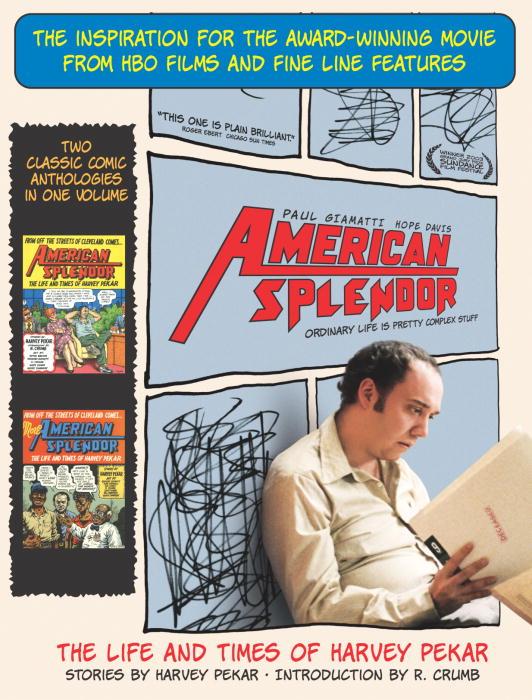
AMERICAN SPLENDOR (First Ballantine Books Printing, 2003; Softcover)

Collects selections from American Splendor #1-11 (cover dates May, 1976- 1986)

Writer: Harvey Pekar
Artists: Kevin Brown, Gregory Budgett, R. Crumb, Gary Dumm, Gerry Shamray, Sean Carroll, Sue Cavey, and Val Mayerik

I have been going through a rough patch in my personal life over the past few months. I won't go into the whats or whys or wherefores of it all, suffice it to say that life is a strange thing and that there are no guarantees. A friend of mine repeatedly urged me to check out the works of Harvey Pekar. He told me that his life mirrored mine at the moment and vice versa. I trust the opinion of this friend, as he turned me on to Bukowski and is an artist who has produced work which I hold in extremely high regard.


Harvey Pekar is the star and hero of his own strip, the autobiographical American Splendor. While I know nothing about underground comics (or comix, as the kids who are now grandparents called them at the time), I can appreciate how far ahead of it's time this comic was. I am confident in saying that Pekar invented an entirely new language for comic books. Nothing out there at that time read like this. It was so far ahead of it's time that it reads as contemporary with 2016 eyes. I read things in the here and now and also consider the work within the context in which it was published, and this holds up on both counts.

Pekar is a well-intentioned (if self-defeating) free thinker who is his own best friend and worst enemy in one. In that regard he is exactly like the rest of us, at least those of us who are humble and like the simple life. Like Pekar, I toil in a seemingly menial job but am content with the living that I have eked out because of it. I would rather have relative financial security and let my mind soar at work than be stuck doing something “important” which would yield only less happiness for me. My only ambition in this life is to be happy, or as close to happy as I can be within the context of my circumstances. Also like Pekar, I value truth and loyalty over flash and hype in people. Pekar cannot fathom why virtues are not more valuable than monetary success, and he's right. A great artist whose work brightens the world can be poor while someone who does things to screw people over gets rewarded financially. Don't both things add value to life? One adds cultural value, the other financial value to a company's bottom line. What does that say about us as a society when we view and reward the one which is worse for everyone more favorably?


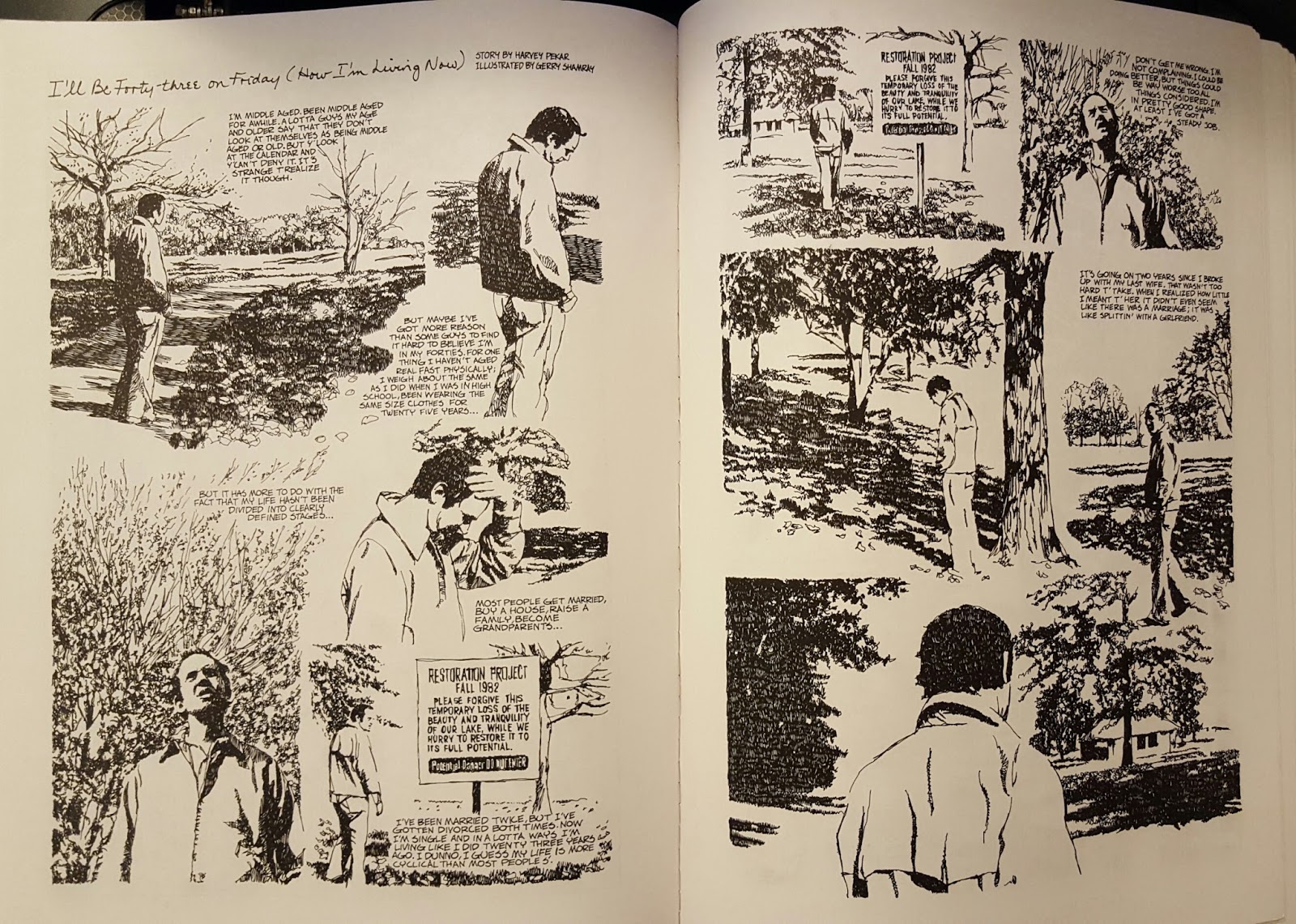
Pekar writes about ordinary life, which sounds boring on paper but in reality is the real heavy, kids. Waking To The Terror Of The New Day is profound. An Argument At Work is one of the many reasons that this book spoke to me. Leonard & Marie was touching. Stetson Shoes spoke to me for a reason I won't share here. I'll Be Forty-Three On Friday (How I'm Living Now) is the best story in the book. Pekar makes nothing seem like something important. Maybe it is because real life is important. Folks tend to sweep the little things under the rug when they should maybe stop and pay attention, because the little things become the moments that define us. At least that is the realization that I have come to over the past few months. The big picture versus the little picture. Focus on the one and you lose sight of them both.


Pekar touches on many themes such as race, socioeconomic circles, gentrification and integration and the effects thereof, and other truths. The lighter fare offsets the heaviness or preachiness of the weightier topics, resulting in a well-balanced slice of life.

The art is a mixed bag. While I am admittedly of the Adams/Kirby/Ditko/Steranko school of thought most of these cats carry the story forward well enough. A few of them are very good, with ideas far outside of the box of what comic books could look like during this time frame.

Middle age is a strange thing. I am no longer a young man ready to inherit the world, nor am I ready to give up on it. I'm not old enough to reap the rewards that old age brings. Middle age is like you're here, only here isn't necessarily what you once thought it would be, and even if you wanted it it may not be where you belong anyways. If there are answers to what life is, I certainly haven't found them yet. Harvey Pekar might have, though. He at least tries to point you in the right direction. Maybe further reading of his work will reveal the answer.
Junk Food For Thought rating: 5 out of 5.

The OCD zone- This is much wider than a standard trade paperback.
Linework restoration: I haven't done any comparison with the original comic books and therefore have no comment.
Paper stock: Thick uncoated stock.
Binding: Perfect bound trade paperback. It should be noted that this is a library copy and has been read countless times and has held strong.
Cardstock cover notes: Thick cardstock cover which has weathered repeated handling and hands far less careful than mine countless times.