Showing posts with label Timely Comics. Show all posts

Thursday, May 21, 2015

Review- MARVEL MASTERWORKS: GOLDEN AGE SUB-MARINER VOL. 1


MARVEL MASTERWORKS: GOLDEN AGE SUB-MARINER VOL. 1 (Marvel, 2012; Softcover)

Collects Sub-Mariner Comics #1-4 (cover dates Spring, 1941- Winter, 1941)

Writers: Bill Everett, Ray Gill, Paul Gustavson, Lou Glanzman, Stan Lee, Art Gates, and Basil Wolverton, and other, unidentifed writers

Artists: Bill Everett, Paul Gustavson, Alex Schomburg (covers), Richard Isanove (covers), Harry Sahle, Alan Mandel, Mickey Spillane, Basil Wolverton, Charles Nicholas Wojtkoski, Witmer Williams, Ben Thompson, Sam Gillman, George Mandel, Mike Roy, Al Fagaly, Jimmy Thompson, and other, unidentified art assistants

This was a double dip. I had the original hardcover release which was done during the time when Marvel didn't have their remastering techniques perfected yet. Always one to enjoy his comics in the finest “fidelity”, I scooped up this softcover version as it blows away the original hardcover release. Since this was a double dip, it was also a reread, although it I only read the hardcover once in either 2005 or 2006. I honestly didn't remember much about these stories so it was essentially a fresh read.

Bill Everett was and is a genius, and he lived an interesting life to boot. A hard drinking three packs a day smoker, tall-tale telling character, he created or co-created a number of characters, notably Namor The Sub-Mariner and Daredevil. Golden Age Sub-Mariner is a badass. I love the might makes right mentality of Golden Age Comics. He usually fights Nazis in these stories, made all the more remarkable since these issues were all released prior to the United States entering World War II.


Paul Gustavson's The Angel is the recurring back-up feature, and he gets a full 20 pages per issue. (Comic books were 64 pages back then.) He doesn't have any super powers, being closer to pulp heroes of the 1930s while looking like Superman. His exploits probably ape other things that I am unfamiliar with. These are still great reads, high on fun and low on common sense. Lots of whodunit and Horror-tinged action.

There are a handful of other text stories and one page gag strips (one by Basil Wolverton ) rounding out the issues. I really enjoyed these comics. Golden Age material is an acquired taste, but if you can accept the limitations of the era and the fact that these tales don't adhere to any rules because they made them up as they went along then you will dig this stuff. I love the old fashions, cars, architecture, and slang. And in the end the good guys always win, making this the most escapist read you can get here in 2015.
Junk Food For Thought rating: 4.5 out of 5.

The OCD zone- I really like these softcover Masterworks, as they are slightly wider than a standard trade paperback and lay flat in one hand like a big fat periodical, which is wonderful.

I really wish that Marvel would reconsider their plans to nix this line of books.

Linework and Color restoration: As good as it is going to get. The linework and color palette are faithful to the original comic books.

Paper stock: Decent weight matte finish coated stock. I love it.

Binding: Perfect bound trade paperback.

Cardstock cover notes: Laminated cardstock.

Friday, July 6, 2012

Review- MARVEL MASTERWORKS: GOLDEN AGE MYSTIC COMICS VOL. 1


MARVEL MASTERWORKS: GOLDEN AGE MYSTIC COMICS VOL. 1 (Marvel, 2011; Hardcover)


Collects Mystic Comics Nos. 1-4 (cover dates March- July, 1940)

Writers: Will Harr, Joe Cal Cagno, Robert O. Erisman, Leo Stalnaker, Norman Daniels, S.S. Bedford, Bill O'Connor, George Kapitan, Andrew McWhiney, and others

Artists: Jack Binder, Fred Schwartz, Alfred H. Newton, L.F. Bjorklund, Fred Guardineer, Arnold Lorne Hicks, E.C. Stoner, Gus Ricca, Eddie Heron, Malcom Kildale, Ben Flinton, Leonard Sansone, Harry Sahle, George Harrison, Bill Everett, Russ Lanford, Alex Schomburg, and others


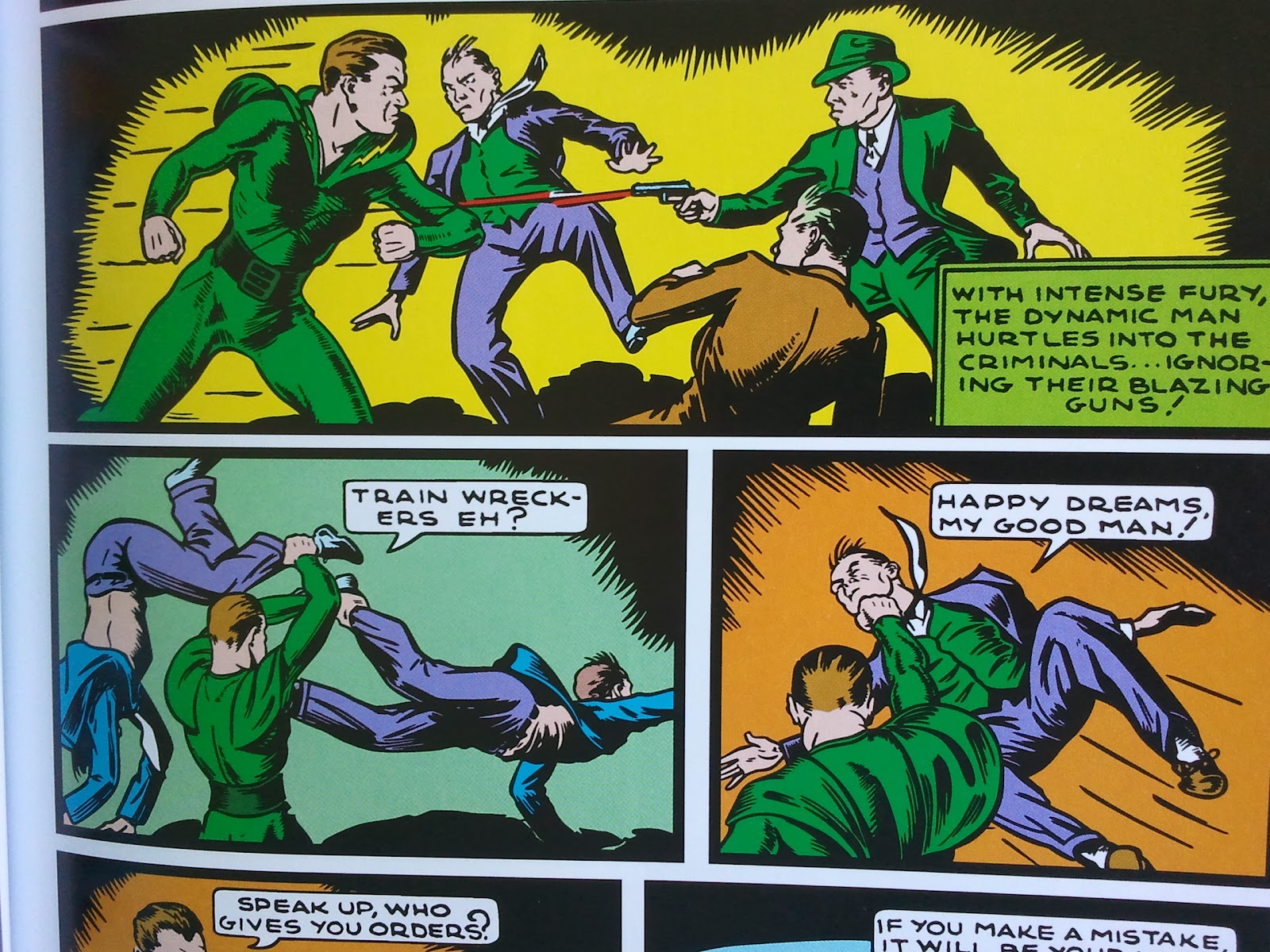
I have read a pretty fair amount of Golden Age comic books, thanks to wonderful collected editions like this one. The novelty of something being old, and of reading something solely for historical value, is enough to draw me into buying these books. Having said that, this book falls short on entertainment value in the first two issues. They were filled with excess inventory strips from various sweatshop comic packaging companies, and were a chore to get through. Issue 1 especially sucked. By issue 3, things were picking up, and by issue 4, I was in. The Black Widow? Dynamic Man? The Thin Man? I am a sucker for this type of cheesy goodness. 


I am also a sucker for the politically incorrect, excessively violent nature of these old-tyme comic books. Heroes killed villains at every turn, and you cheered them on for it. I can't cheer on the X-Men doing that because it goes against the foundations of the characters, but for these post-Pulp heroes, it's kosher. 


If you have read The Twelve and are curious about the origins of Dynamic Man and the Black Widow, then this is book is a must read. Dynamic Man's origin is incredibly stupid, even by Golden Age standards. He was a synthetic man created for a better tomorrow. So rather than just going out and bashing in the heads of the bad guys, he gets a job with the FBI. Wouldn't the FBI have had rigorous background checks in place, even back in those days? Its as nonsensical as the Golden Age Human Torch, who starts out as an android, becomes a cop, and is never referred to as an android again until the '60s. 


The Black Widow is great. I love the whole servant of Satan angle, as it must have been super cutting edge at the time. The Spectre was going on during this time over at National Periodicals (DC), and I am curious what other macabre heroes existed during this era. Can anyone point me in the right direction? The Thin Man pre-dates Plastic Man, and contorts his body in many of the same ways as ol' Plas. Influence or happy coincidence? Who can really say, since these cats are mostly dead and gone. 


The OCD zone- Superb color and linework restoration faithful to the original issues, godlike paper, and sewn binding, all of which make my heart flutter. 


Saturday, March 3, 2012

Review- Marvel Masterworks: Golden Age Marvel Comics Vol. 6


MARVEL MASTERWORKS: GOLDEN AGE MARVEL COMICS VOL. 6 (Marvel, 2011; Hardcover)

Collects Marvel Mystery Comics Nos. 21-24 (cover dates July- October, 1941)

Writers: Ray Gill, Stan Lee, and other uncredited, unidentified writers

Artists: Carl Burgos, Bill Everett, Alan Mandel, Ben Thompson, Al Avison, Joe Simon, Paul Gustavson, Bob Oksner, Jack Kirby, Al Gabriele, Chu Hing, Frank Frollo, and Sid Greene, as well as other unidentified artists/assistants

Those of us following this line of books are familiar with the creators and characters by now, but for those of you 'viewing at home' who are not familiar with this title, I'll give you a brief recap.

This was Timely's (Marvel's name at the time) flagship title, and was an anthology series. The Human Torch & Toro were the title's headliners, followed by Bill Everett's brilliant Sub-Mariner. This strip is worth the price of admission alone. The Patriot is an also-ran, sort of a dollar store Captain America, relegated to 4 and 5 page stories of no importance and little value. Ka-Zar the Great is fun as usual, and always seems to stagger into some unknown section of the jungle which he is supposedly in charge of. Terry Vance, the Schoolboy Sleuth is a charming slice of Americana. 


The Vision has fast become a favorite of mine, largely because of the dream team of Simon and Kirby, who put their trademark punch into the proceedings. The Angel seems to lose some steam after Issue 21, as Gustavson no longer handles the creator duties on the strip. It was a bummer to see the quality dip after such a tremendous run, but Al Avison is no slouch in the artwork department, either. It's the writing that really took a hit after Gustavson jumped ship.


Volume 7 is due out this year, and I look forward to the continuation of this line of books. With any luck, we will see the entire run collected in hardcover someday. That would really be something, wouldn't it?

The OCD zone- If loving Marvel Masterworks is wrong, then I don't want to be right! High quality artwork and color restoration, high quality paper and sewn binding...these books are things of beauty. My OCD glows as I read these books. Worse still, I can't help but take a big whiff of the toxic Chinese ink after I crack the cellophane on these books. It's like a coke-head snorting a line. Most people will unfortunately never know the joy of inhaling those wonderfully toxic Chinese ink fumes.

Follow my blog on Facebook.

Help us send DC a message to let them know that we want them to make their hardcover books with sewn binding, no gutter loss, and lay flat. Join the crusade!

Saturday, January 21, 2012

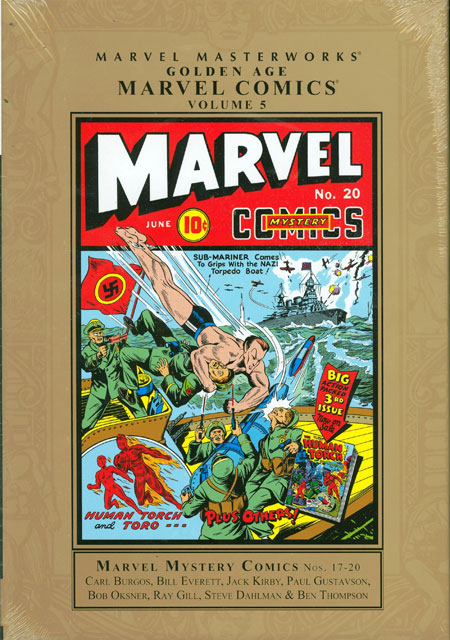
Review: Marvel Masterworks- Golden Age Marvel Comics Vol. 5


MARVEL MASTERWORKS: GOLDEN AGE MARVEL COMICS VOL. 5 (Marvel, 2010; Hardcover)

Collects Marvel Mystery Comics Nos. 17-20 (cover dates March- June, 1941)

This is the cream of the Timely Comics crop. All of the greats are helming their original creations since they haven't been drafted by Uncle Sam to serve in World War II yet. The Nazis are recurring antagonists across the strips, which is interesting considering that all of these issues were published well before we entered World War II. Every 64-page issue was divided up among the following strips:


The Angel by Paul Gustavson- The Angel is the pulp hero throwback of the title, and has the best continuity out of all of the strips in the title. This feels like an old movie serial cliffhanger, with each issue ending with a seeming disaster that our hero could not possibly survive. The Angel is arguably the most violent of the characters here, engaging in rough and tumble fisticuffs at the drop of a hat. 


The Vision by Joe Simon and Jack Kirby- The concept is pure cheese, but what delicious cheese it is! The Vision enters our dimension through smoke? And decides to fight evil?? No further explanation is ever given, and honestly, none is needed. Joe Simon and Jack Kirby are great, and this bursts with all of the energy that you would expect from the pair. 


The Sub-Mariner by Bill Everett- The cream of the Timely crop, Everett's Prince Namor is a hot headed, egotistical prick...a characteristic that is employed to this day. Everett's artwork is a joy, and I am looking forward to the upcoming Bill Everett Archives from Fantagraphics Books.

The Human Torch by Carl Burgos- I am not as enamored with the Torch and Toro as I was once was. I own, and have read, all of the Golden Age Marvel Masterworks, so I am well versed in their exploits. Burgos is a less capable storyteller than his peers, and his artwork is often crude by comparison. I enjoy them, but like the other strips much more. The thing that grinds my nerves is that Burgos established the Torch as an android early on and then ret-conned him into being a human. I am sorry, but I have a real hard time with this.


Ka-Zar the Great by Ben Thompson- Fast paced and far out jungle fun. There is always some unkown section that the Lord of the Jungle doesn't know about, with giants and Lizard-People or whatnot. Too funny.

Electro, The Marvel of the Age by Steve Dahlman- This “Iron-Man” is a ridiculous and often tedious read. The lettering (by Dahlman?) is horrible, with huge swaths of ugly lettering obscuring the artwork, not that this is a huge problem. Dahlman has not gone down in history as one of the greats of the Golden Age for a reason. Professor Zog is becoming more combative, no longer being content with merely controlling the robot by remote. Now he uses a gun and caps criminals.

Terry Vance, the Schoolboy Sleuth by Ray Gill and Bill Oksner- A product of the time, this is an okay read. Some of these concepts could be retooled for modern comics, but not this one. It has its charms for sure.

Kudos to Marvel for preserving these issues, as they originals are too obscure and too expensive for any but the most affluent collectors to afford to read. While these Golden Age Masterworks are pricey ($64.99 MSRP), they are far cheaper than a beater reader copy of even one issue, which would be several hundred dollars.

The OCD zone- The paper, the binding, the color and linework restoration are all wonderful. Two thumbs up. I would give it more, but I only have two thumbs.  

Saturday, May 21, 2011

Review: Marvel Masterworks Golden Age Captain America Vol. 4


MARVEL MASTERWORKS: GOLDEN AGE CAPTAIN AMERICA VOL. 4 (Marvel, 2010; Hardcover)

Collects Captain America Comics Nos. 13-16 (cover dates April- July, 1942)

Captain America rocks! I love these Golden Age comics, where Cap fights the Nazis, the Japs, and the Red Skull. I love the absolute good and evil, the absolute heroism, and the absolute belief that America was in the right. Al Avison takes over the artwork because Joe Simon and Jack Kirby had left Timely (Marvel) for National (DC) to do the revamped Sandman. There were many hands involved in the artwork, i.e. inking, and I suspect that many of the people that assisted Simon & Kirby assisted Avision, because there is a definite continuity in the appearance and layout of the strip. A very young Stan Lee turns in a script in Issue 16 where Cap fights the Red Skull, and it's great.

The Secret Stamp was a regular back-up feature in this title. He was a little boy who sold newspapers and war stamps and fought fifth columnists, etc. It's one of those slices of Americana that would never fly today. The Imp (created by a very young Stan Lee) is a godawful "kiddie" strip featuring a highly annoying, rhyming creature. I couldn't even bear to read it after it's first appearance. Once was enough. I tried reading it, but it just sucked so bad that I had to skip it. Fortunately, the goodness of the Captain America and Secret Stamp features far outweigh the suckiness of the Imp.

Friday, January 28, 2011

Review: A Sickness in the Family; Bram Stoker's Death Ship; Marvel Masterworks Golden Age Daring Mystery Vol. 2


A SICKNESS IN THE FAMILY (Vertigo/ DC, 2010; Hardcover Original Graphic Novel)

This is another one of those black and white "graphic novel" sized books, and for some reason or another I really like this format. This story is decent, but I am indifferent to the artwork. The ending has a sufficient twist in that there is a payoff, but afterwards this story feels like a one trick pony. There is no reason to re-read this, as there doesn't feel like there are any layers to peel off. Solid entertainment and worth a read...one read. At least the characters are all fully formed.


BRAM STOKER'S DEATH SHIP (IDW, 2010; softcover)

Collects Bram Stoker's Death Ship Nos. 1-4 (cover dates May- August, 2010)

Y-A-A-A-W-W-W-NNNN. The artwork and pacing of this make this something of a bore. What should have been tense and intense instead feels relaxed and uninvolved. The artwork is scratchy and unfocused, which is not my cup of tea. I was suckered into this by the beautiful cover art of the individual issues in Previews, thinking to myself "Oh, that looks and sounds very cool. I will definitely pick the trade of that up when it come out". Books like this are the reason that I now either pick up and flip through single issues of unknown quantities or buy the first issue and give it a test drive before committing to buy the whole thing. This was underwhelming.


MARVEL MASTERWORKS: GOLDEN AGE DARING MYSTERY VOL. 2 (Marvel, 2010; Hardcover)

Collects Daring Mystery Comics Nos. 5-8 (cover dates June, 1940- January, 1942)

In this, the second and final volume in this line of Masterworks, we get a hodgepodge collection of stories ranging from brilliant to banal for the era. In Daring Mystery No. 5 we get The Jelly of Doom, a Fiery Mask strip by Joe Simon and Kack Kirby, where the Fiery Mask fights Dork, Evil Scientist. Yes, that is his name...Dork. The interesting thing about the story is that the "jelly" is really more of a "blob", and pre-dates that movie by 18 years. Simon & Kirby also help launch Captain Daring, a Buck Rogers knock-off who quickly fell back to Earth. There are lots of fun and worthwhile reads here: Monako, Prince of Magic; The Falcon; Blue Diamond; The Silver Scorpion; The Fin, by the always Godlike Bill Everett; Dynaman. All of them are quite good. Then we get Marvex, the Super Robot, which is asinine, and I am dumber for having read it.

As is the case with all Masterworks of the last few years, everything is perfect: paper, binding, restoration, coloring, etc., are all well within my OCD sweet spot range. Everyone has a vice, and mine is high-end hardcover reprints like this.

Sunday, August 2, 2009

Originally posted on my myspace blog on 4/27, 5/9, and 5/19/2009


THE IMMORTAL IRON FIST VOL. 3: THE BOOK OF THE IRON FIST (Marvel, 2008; Hardcover)

Collects The Immortal Iron Fist Nos. 7, 15, 16, Immortal Iron Fist: The Origin of Danny Rand and Immortal Iron Fist: Orson Randall and the Green Mist of Death (cover dates August, 2007- October, 2008)


THE IMMORTAL IRON FIST VOL. 4: THE MORTAL IRON FIST (Marvel, 2009; Hardcover)

Collects The Immortal Iron Fist Nos. 17-20 and Immortal Iron Fist: Orson Randall and the Death Queen of California (cover dates September, 2008- January, 2009)

Matt Fraction keeps it moving, while the artwork varies from passable to unappealing. The storytelling and pacing of it is fine, but I am not a fan of scratchy artwork. The lettering by David Lanphear is probably the aesthetic highlight of this title. *S-P-O-I-L-E-R-S* This whole thing has been building for a while, and if this is indeed the climax, then it is a letdown. All signs point to it not being the end of the Seven (or is it now Eight?) capital cities of Heaven, so we'll have to wait and see. 

Immortal Iron Fist: The Origin of Danny Rand is a slightly tweaked and re-packaged version of Marvel Premiere #15 and 16, rendered with modern coloring. Old school artwork does not work well with all of the gimmicky bells and whistles. There is a major continuity snafu in these arcs. In Iron Fist's origin, he was 9 years old when he entered the mystical city of K'un L'un. Fine. The city's entrance/exit appears every ten years on Earth. Check. That makes him 19 in 1975, which in Marvel time isn't very long. It is estimated that since Fantastic Four #1 in 1961, approximately 12 years have passed. Some disagree, saying that it is less. So, if Peter Parker was still a college student in Marvel Comics circa 1975, it would put him in his early 20s. It is estimated that his age is 25-27. So, since 1975 we have had maybe 6 or 7 years of continuity unfold. Are you with me? Why is it that this huge sticking point in this arc is Danny Rand's 33rd birthday? It is not possible! If here were 19 in 1975's comics, then he couldn't possibly be older than 25 or 26. It's called continuity, Marvel! And no, I don't live in my Mom's basement, and I have kissed many girls, so don't even try that argument! Continuity is very important in a serialized format like comic books.


JLA: THAT WAS NOW, THIS IS THEN (DC, 2008)

Collects JLA Classified Nos. 50-54 (cover dates Early March- May, 2008)

Yes, this is DC, but it is DC by Roger Stern and John Byrne! These two old-schoolers kick out the jams and show the new-jack, deadline missing "artistes" how it is done! Everything is perfect...Roger Stern's writing is clear and concise, undoubtedly referring to continuity but doing so in such a way that a non-DC fan like me can easily grasp and follow exactly who these people are and what they can do. Writing for all ages is not an insult, people, it's a compliment and takes a lot of talent to write something that a 10 year old and a 35 year old can both enjoy. John Byrne's artwork provides fantastic pacing, plenty of ramped-up action sequences, and is just nice to look at! Mark Farmer is a solid inker that complements Byrne's pencils, and Allen Passalagua's coloring is contemporary without being gimmicky or overpowering to the artwork. Computer color separations and digital painting can sometimes be so overwhelming that you have to wonder if there was ever any penciling going on there before the colorist got involved...not so here. I honestly couldn't care less about Batman, Superman, etc., but I would read any title that Stern and Byrne did on a regular basis.


IRON MAN: DRAGON SEED SAGA (Marvel, 2008)

Collects Iron Man Nos. 270-275 (cover dates July- December, 1991)

Good stuff written by John Byrne with artwork by Paul Ryan. Fin Fang Foom, the Mandarin, and ten other dragons...what is not to love here? The coloring, and especially the lettering are dated and below today's standards, but this was still an absolute blast to read. Paul Ryan is a competent penciler, but lacks a certain polish. A lot of the lettering in the days of yore sucked. If it's not Artie Simek or Tom Orzechowski, then it generally detracts from the artwork.


WEAPON OMEGA (Marvel, 2008)

Collects selections from Marvel Comics Presents (Vol. 2) Nos. 1-12 (cover dates November, 2007- October, 2008)

Yet another half-hearted attempt at an Alpha Flight reboot. Come on Marvel, just jump in with both feet! The Omega Flight mini-series that spun out of Civil War was decent, but I wish that Marvel would make amends with John Byrne (and vice versa) so that Byrne could come back and give his baby a kick in the butt. All in all, this was a decent read but I would like to see an Alpha Flight ongoing.


MARVEL MASTERWORKS: GOLDEN AGE CAPTAIN AMERICA VOL. 3 (Marvel, 2009)

Collects Captain America Comics Nos. 9-12 (cover dates December, 1941- March, 1942)

This book is a heaping helping of Golden Age fun! Joe Simon & Jack Kirby's Captain America frickin' rocks. I can't get enough of these dated/slightly corny/possibly offensive snapshots of this bygone era. Like all Golden Age comic books, there are back-up features. Headline Hunter sucks! He is a news reporter who somehow always gets involved in some adventure while chasing down a story. Hurricane, Master of Speed is always fun. His alter ego is named Harry Kane. Grooooooooaaaaaannn. It was 1941. He mysteriously gets a fat, oddly dressed sidekick named Speedy Scriggles in Issue 10, with no explanation given. Father Time is always hilarious, as his costume consists of a scythe/sickle, a cape with a hood, a pair of shorts, gloves, boots, and some underwear, and a clock on his chest. Not on a shirt, but ON HIS ACTUAL CHEST! None of his adventures or powers have anything to do with his name, and the fact that he uses his sickle as a pole vault is hilarious. Cartoon characters were all of the rage during this time, in animated shorts at the movie theatre and in comic books. Never one to turn down a buck, Stan Lee created the Imp, an odd character who didn't last very long. All in all, a lot of fun, and a total bargain considering what you would pay even for beat up copies of the originals...if you could even find them!


SPIDER-MAN: A NEW GOBLIN (Marvel, 2008)

Collects Amazing Spider-Man Nos. 176-180 (cover dates January- May, 1978)

This is one of those left-field trades. Why on Earth would they collect a 30 plus year old arc that has no bearing on today’s continuity? I’m not complaining, just curious! I owned all of the floppies as cheap-o back issues some 20 odd years ago. Len Wein's writing is great with the exception of the over-used phrase "web slinger", as if everyone who meets him would call him that. It would be more fun if you made a drinking game out of it, I imagine. While most of the peeps on the Intrawebs hate on Ross Andru, I actually enjoy his take on the character. Sure, it's a bit rough around the edges, but his action sequences are good and he met his deadlines. Trades like this are great because they offer a slice of Bronze Age goodness at an affordable price.


ESSENTIAL SUPER-VILLAIN TEAM-UP VOL. 1 (Marvel, 2004)

Collects Avengers Nos. 154-156, Champions No. 16, Giant-Size Super-Villain Team-Up Nos. 1, 2, Super-Villain Team-Up Nos. 1-14, 16, 17, and selections from Astonishing Tales Nos. 1-8 (cover dates August, 1970- June, 1980)

This book was a hit or miss affair, depending on the creative team(s) involved, and that pretty much sums up the biggest problem with Marvel in the '70s: a lack of consistency. There are some gems between these covers, though. Astonishing Tales starts off strong, with writing by Roy Thomas and artwork by EC alumni Wally Wood. Wood stays on board for issues 3 and 4 with Larry Lieber (Stan Lee's brother, for the uninitiated) handling the scripts. Gerry Conway and Gene Colan wrap up the AA stuff well, and this screams for a Marvel Premiere Classic Hardcover! SVTU is handed off like a baton, from every Bronze Age journeyman one would expect: Bill Mantlo, Steve Englehart, Tony Isasbella, Herb Trimpe, etc. The series runs out of steam, and gets cancelled with Issue 14...or did it? It was always a bi-monthly affair, and Issue 15 was a reprint of two AA issues. Six months after that, the series gets re-tooled with the Red Skull and the Hatemonger for an interesting, entertaining tale, and then...nothing. Fin.


ULTIMATE SPIDER-MAN VOL. 10 (Marvel, 2009; Hardcover)


Collects Ultimate Spider-Man Nos. 112-122 (cover dates October, 2007- July, 2008)

I am done with this title. Brian Michael Bendis' writing sucks, and so does new artist Stuart Immonen. Why couldn't they get the guy(s) who did the beautiful cover art to do this series? Also, this over-sized hardcover seems downright anorexic when you compare it to the earlier volumes on the shelf.


THE AMAZING SPIDER-MAN OMNIBUS VOL. 1 (Marvel,2007; Hardcover second printing)

Collects The Amazing Spider-Man Nos. 1-38, Amazing Spider-Man Annual Nos. 1, 2 and selections from Amazing Fantasy (Vol. 1) No. 15 and Strange Tales Annual No. 2 (cover dates August, 1962- July, 1966)

I have bought the issues contained in this hardcover countless times. First, I bought many of them off of the stands in the '80s when they were reprinted in monthly intervals in Marvel Tales, so that really gave me the thrill of serialization like they did when the issues first came out. There was no Internet as such, so I didn't know what was coming next until those Official Marvel Indexes (Indices?) came out in 1985. I acquired the actual floppies of some of these in the '80s, in various condition: Issues 8, 19, 20, 25-27, and 29-32, so that makes it the second time that I purchased those issues. Then I bought the Masterworks containing these issues, then the first printing Omnibus so that I could get the state of the art restoration and faithful re-coloring, only to have it marred by glued binding. A 1,088 page book will not lay flat with glued binding, and weighing in at over 7 pounds, there is no way that you want to hold this thing while reading it. So, I did something that I hate: I rewarded Marvel by buying the second printing because it has sewn binding (selling the other copy on eBay).

These issues are among the greatest comic books ever made. Stan Lee and Steve Ditko kept upping the ante', and each issue seemed to top the last. I will try to keep my analysis to a minimum, as everything that I wish to say has undoubtedly been said elsewhere on the Internet or more eloquently in one of the many books on Steve Ditko out there. Ditko has such a fantastic sense of pacing, and as the sole plotter as the series progressed, really deserves the lion's share of the credit in my opinion. Of course Stan Lee can write, and he and Kirby created the name and initial idea for Spider-Man, but Ditko scrapped that idea and re-worked into something fresh. The Crime Master in Issues 26 and 27 is undoubtedly Alan Moore's inspiration for Rorschach from the Watchmen. It is common knowledge that Rorschach was based on Charlton's The Question (by Steve Ditko), but look at the Crime Master. His mask, etc. It's Rorschach! Couple that with Moore's love of Ditko's tightly structured 9 panels per page layout, and there you have it. 


Stan Lee deserves credit as well, as his snappy, witty dialogue and narrative helped make these some of the most memorable stories in all of comics. It should also be mentioned that he was writing or plotting all of Marvel's titles during this time period, 8 a month, while Ditko held down this title and Dr. Strange, among occasional fill-ins. So tell me, what excuse do modern day comic 'artistes' that can't even turn in one comic book per month on time have now? These old school cats created it as they went along, never missing a deadline, and changed the world. I have always subscribed to the notion that creativity coupled with work ethic equals success. Self-absorbed artistes who sit around wondering what everyone will think of everything that they do will never accomplish what these cats did. Food for thought for the starving artists out there.

The villains! Lee and Ditko tossed off brilliant villains that are staples to this day. I will omit repeat appearances and villains from other titles, as this stuff is readily available on the Internet. 1. The Chameleon 2. The Vulture and the Terrible Tinkerer (OK, there were some duds here) 3. Doctor Octopus 4. Sandman 6. The Lizard 8. The Living Brain (see Tinkerer comment) 9. Electro 10. The Enforcers 13. Mysterio 14. Green Goblin 15. Kraven the Hunter 20. The Scorpion 25. Profressor Smythe and his eventually named Spider-Slayer robots 26. The Crime Master 28. The Molten Man (one of my favorites) 30. The Cat 36. The Looter (later called the Meteor Man) 37. The Robot Master All of this in less than 3 years' time. Take that, Bendis! This is the Bible of comic books, kids. Go out and get it and worship at the altar of the House of Ideas!


SHOWCASE PRESENTS THE HOUSE OF MYSTERY VOL. 3 (DC, 2009)

Collects The House of Mystery (Vol. 1) Nos. 212-226 (cover dates March, 1973- September, 1974)

At last! This series of phone books reached the issue that was the reason that I ever got into Horror comic books in the first place: House of Mystery #222. My oldest sister had that comic book, and let me read it as a small child, and it scared the living crap out of me. It was coverless by the time I got to it, and I spent years looking for it in back issue bins, from 1983 until 1989, when I snagged a copy in Near Mint condition for $1.00. The first story in it, Vengeance Is Mine is decent, but it was the second story, The Night of the Teddy Bear, with it's insanely creepy artwork by Alfredo Alcala that made my skin crawl as a 7 or 8 year old. The idea of a guy wearing a teddy bear mask killing people really struck a chord in me. Of course I realize how ridiculous the premise is an adult. The story takes place in London in 1872, riffing on Jack The Ripper while simultaneously pre-dating both that killer and the teddy bear stuffed animal itself! They didn't come about, or at least weren't called that, until the early 1900s! Technicalities aside, the story has a spectacularly chilling sequence on Page 9 (or 250 in this 518 page phone book) that is still effective to this day.

Of course there is more goodness in this book aside from that issue. The aforementioned Alfredo Alcala is one of those 'lost' greats, who seemingly vanished into the mists of time. The stories are good, solid, old school Horror by Doug Moench, Jack Oleck, Michael Fleisher (especially Issue 221's Pingo and the aforementioned Teddy Bear), Marv Wolfman, Gerry Conway, and Len Wein. This series has so much eye cnady, courtsey of artists extraordinare Berni Wrightson (who handles mostly covers and splash pages, but also occassionally contributes art to a story), John Calnan, Adolfo Buylla, Ruben Yandoc, Sonny Trinidad, Bernard Baily, Nestor Redondo, Eufronio Reyes Cruz, Ralph Reese, Bill Draut, Neal Adams, Frank Giacoia, Jess M. Jodloman, Curt Swan, and Murphy Anderson. Most of these cats never achieved any sort of fame, but are still top flight artists whose work deserves to be mentioned here. The sales on this line have been strong, and I hope that they continue cranking them out. Or better yet, put them out as DC Archives.

Thursday, July 30, 2009

Originally posted on my myspace blog on 2/22 and 3/8/2009


SHE-HULK VOL. 3: TIME TRIALS (Marvel, 2006)
Collects She-Hulk (Vol. 2) Nos. 1-5 (cover dates December, 2005- May, 2006)
SHE-HULK VOL. 4: LAWS OF ATTRACTION (Marvel, 2007)
Collects She-Hulk (Vol. 2) Nos. 6-13 (cover dates May-December, 2006)
SHE-HULK VOL. 5: PLANET WITHOUT A HULK (Marvel, 2007)
Collects She-Hulk (Vol. 2) Nos. 14-21 (cover dates January- August,2007)
Dan Slott writes some great stuff here, with jokes that only hardcore Marvel zombies will get. Not exactly a title I would recommend to a newbie, though. Juan Bobillo’s artwork is far too mangish and cartoony for my taste, but Scott Kollins does a great job on Issue 4. Issues 6 and 7 have excellent artwork by Will Conrad, and Ron Frenz pops in on Issue 9, but most of the artists and colorists on this series are sub-par. I was thrilled to see the return of the Man-Wolf, as I have been a sucker for him since my friend had Amazing Spider-Man No. 189 when I was 6 and showed it to me. I hunted down that and several other back issues with Man-Wolf in '83-84. I snagged ASM 124 and 125 for $1.00 each in Fine condition back then and still have them, but I digress. This was a witty, light-hearted and fun series that I actually want to read again someday.


MARVEL MASTERWORKS: GOLDEN AGE ALL-WINNERS VOL. 3 (Marvel, 2008)
Collects All-Winners Comics Nos. 9-14 (cover dates Summer, 1943- Winter 1944-45)
Carl Burgos and Bill Everett were all busy serving Uncle Sam when these issues were originally published, but the machine rolled on. The page counts gradually decreased, as paper became more scarce and expensive during World War II. These days, they would simply jack up the price, but back then they wanted to maintain the 10 cent cover price. This continued into the early '60s. These stories are par for the course for the Golden Age, with the exception of the excellent Whizzer story from All-Winners No. 13: The Maze of Madness, which for some reason creeped me out. All in all, these Golden Age Masterworks offer comic book fans a chance to read these long lost treasures at an affordable price.


MARVEL MASTERWORKS: THE AVENGERS VOL. 8 (Marvel, 2008; Hardcover)
Collects Avengers Nos. 69-79 (cover dates October, 1969- August, 1970)
Outstanding stuff by Roy Thomas (writer), with art by John Buscema, Sal Buscema and Tom Palmer. This is the first Golden Age of The Avengers, when they had a great team and great villains. Bendis should pick this book up and take notes. Sure, some of Thomas' dialogue is dated and/or slightly corny, but at least there aren't two page spreads and splash pages interrupted by talking head pages!


SIN CITY VOL. 3: THE BIG FAT KILL (Dark Horse, 2005)
Collects Sin City: The Big Fat Kill Nos. 1-5 (cover dates November, 1994- March, 1995)
I really enjoy this series, which surprises me, as I don’t really like Frank Miller’s artwork very much. His writing and sense of pace are excellent, but his artwork just leaves me cold. He should stick to layouts.


MARVEL MASTERWORKS: THE X-MEN VOL. 7 (Marvel, 2008)
Collects Amazing Adventures Nos. 11-17, Amazing Spider-Man No. 92, Incredible Hulk Nos. 150, 161 and Marvel Team-Up (Vol. 1) No. 4 (cover dates January, 1971- March, 1973).
This hardcover collects the "in-between" years of the X-Men, when the title was cancelled due to low sales and existed as a reprint title. The Beast stories in Amazing Adventures, done mostly by Steve Englehart and Tom Sutton, are sensational slices of Bronze Age goodness. I've always enjoyed the "furry" Beast, and wish to _______ (deity of your choice) that someone would undo the cat-like Beast from Grant Morrison's run on the title that seems to have stuck around much too long in the current comics.


DEAD OF NIGHT FEATURING THE MAN-THING (Marvel, 2008)
Collects Dead of Night Featuring Man-Thing Nos. 1-4 (cover dates April- July, 2008)
This was an excellent read that re-tells and revises Man-Thing’s origin. The artist and colorist were different each issue, but they were all excellent. Roberto Aguirre-Sacasa’s writing was great, too. A little more meat wouldn’t hurt, though; I flew through these issues.


MOON KNIGHT VOL. 3: GOD & COUNTRY (Marvel, 2008; Hardcover)
Collects Moon Knight (Vol. 4) Nos. 14-20 (cover dates March- September, 2008)
MOON KNIGHT VOL. 4: THE DEATH OF MARC SPECTOR (Marvel, 2009; Hardcover)
Collects Moon Knight (Vol. 4) Nos. 21-25 and Moon Knight: Silent Knight (cover dates October, 2008- February, 2009).
Mike Benson (writer) and Mark Texeria (artist) (14-19) craft a disturbing tale of the hero(?) on the brink of madness. This title is really gaining steam and is inching towards the top of my favorites. Mike Deodato, Jr. (artist, Number 20) hops on board for a done-in-one, back to the roots story featuring my beloved Werewolf By Night! Issues 21-25 see the quality dip slightly but are still very good. I am not a fan of the Norman Osbourne led Thunderbolts, or the whole redeemed villain angle. The fight with Bullseye was great, though.