Sunday, August 28, 2016

Review- STAR WARS: CHEWBACCA


STAR WARS: CHEWBACCA (Marvel, First Printing, 2016; Softcover)

Collects Chewbacca #1-5 (cover dates December, 2015- February, 2016)

Writer: Gerry Duggan
Artist: Phil Noto
Colorist: VC's Joe Caramagna

My son and I checked this out of the library but he lost interest after the second issue. We also checked out the new Princess Leia series and he had a similar reaction to it. Princess Leia was unreadable, but I managed to solider on and finish this one.

Like the rest of these Marvel Star Wars comic books, this takes place immediately after Star Wars (or Episode IV: A New Hope for you 1981-on new jack types). Chewbacca is flying a ship and crash lands on a planet where he encounters Zarro, a feisty young girl whose father has been enslaved in a mine by a crook named Jaum who is trying to make a deal with the Empire. Long story short, Chewbacca helps Zarro free her father and the rest of their villagers while simultaneously thwarting the Empire.


Reading a series where the star speaks in unintelligible grunts and growls is interesting to say the least. It requires the rest of the characters featured in the story to carry the dialogue. Things move along at a slow pace, and the action is never explosive. This is a quieter tale, and I can see why my 9 year old son became bored with it. It's not without its charms, however, as the artwork and coloring are both top notch. You could certainly do worse than this book. I'm glad that I read it for free, as it is something that is not worth owning in my opinion.
Junk Food For Thought rating: 2.75 out of 5.

The OCD zone- I find library copies to be fascinating studies of durability in the workmanship and materials of these collected editions.
Paper stock: Coated stock with a slight sheen.
Binding: Perfect bound trade paperback.
Cardstock cover notes: Laminated cardstock cover.

Thursday, August 25, 2016

Review- SILVER STREAK ARCHIVES FEATURING THE ORIGINAL DAREDEVIL VOL. 1


SILVER STREAK ARCHIVES FEATURING THE ORIGINAL DAREDEVIL VOL. 1 (Dark Horse, First Printing, 2012; Hardcover)

Collects Silver Streak #6-9 (cover dates September, 1940- April, 1941)

Writers: Jack Cole, Kane Miller, Don Rico, Carl Hubbell, Otto Binder, Bob Turner, D.B. Icove, Dick Briefer, Walter Galli, and Bob Wood

Artists: Jack Binder, Dick Briefer, Jack Cole, Maurice Gutwirth, Hal Sharp, John Hampton, Mac Raboy, Harry Anderson, Carl Hubbell, Dick Dawson, Carl Formes, Walter Galli, Fred Guardineer, D.B. Icove, Richard Norman, Kane Warren, and Bob Wood


The Golden Age of collected editions has made spoiled brats of us all. I remember a time when just the idea of obscure, expensive old comic books beautifully restored and slapped between two hardbacks was enough to send me into a tizzy. Fast forward a dozen years and there are hundreds of collections of this material available for purchase. The novelty of reading said old comics has entirely worn off for me. They now have to impress me either through story or historical significance.

Silver Streak Archives Featuring The Original Daredevil Vol. 1 falls flat on the story side, but the historical significance picks up the slack. Lots of legendary creators were cutting their teeth here. Kids who read this stuff at the time can say that they knew them when. The original Daredevil was one of the best-selling superheroes of his day, which seems curious considering that he is merely a footnote today. Like many forty-somethings, I had never even heard of him until Dynamite's Project Superpowers resurrected a slew of public domain Golden Age superheroes, bringing them into the present.


Like most Golden Age comics, this is an anthology series, with a series of features in each issue that run the gamut. Also like many Golden Age comics, this is not politically correct. One must understand the societal mores of the time and look at it in a purely academic sense, or risk being offended. I keep stuff like this well out of the reach of my son, as I don't want to have conversations about racial stereotypes from 75-odd years ago. And like many Golden Age comics, it is amazing to see how folks seemed to be chomping at the bit for us to get into what would become World War II.

Silver Streak is the headliner, although he would soon be eclipsed by Daredevil. Daredevil's first appearance in issue 6 shows his costume as half yellow, half blue. This is changed to half red, half blue by the following issue. The Claw, his arch-nemesis, seems to have limitless power. It is almost Fletcher Hanks bad in terms of believability.


Jack Cole's Dickie Dean, The Boy Inventor!!! is highly entertaining. The Pirate Prince is an excellent series about “that swashbuckling, daring Robin Hood of the sea”. The Pirate Prince robs pirates and frees the slaves aboard their ships, which is something when you consider the rampant racism and lingering resentment towards blacks in an era when people who remembered slaves were still alive. There is a sense of decency and humanity as to how blacks are portrayed here, which again flies in the face of many of these old comics. It seems downright progressive, and makes me wonder if a reboot of this series would work today.

The rest of the strips are of the garden variety. You have your western knock offs, your Tarzan knock-offs, your Buck Rogers knock-offs, random G-man types, airplane/dogfight stuff, humor strips, etc. None of them are remarkable but most are readable.

Old comics are often unintentionally funny. 


This was an okay read that didn't bowl me over. Like I said, there was a time when any old comics would rock my socks off. That ship has sailed though, as I have read enough of them for me to not be impressed by something solely because of it's age. I have Volume 2 in this line and hope to read it someday.
Junk Food For Thought rating: 3 out of 5.

The OCD zone- This book is light, weighing scarcely more than a pack of cigarettes. I do not smoke, but my mother did. She used to send me to the store on my bike to buy her cigarettes, back in the olden days when kids could go to the corner store and pick up their parent's smokes and everyone thought that it was a-okay.

Linework and Color restoration: Perfectly serviceable restoration, done by scanning original comics and then recoloring them with computers and correcting line bleed, off-register printing, etc. I appreciate the fact that Dark Horse put the time, effort, and money into doing this when so many other publishers just scan 'em and slap 'em into hardcovers.

Paper stock: I love the paper that Dark Horse started using in their Archives back around 2010. It looks like old pulp comic book paper but is super thick, high quality stuff. It is matte uncoated stock and has zero sheen under any light source. Plus it has that delectable Chinese sweatshop printing press aroma. I stop reading every so often just to huff it. Oh yeah, that's the stuff...

Binding: Smyth sewn binding. While the book block has room to flex in the casing you need to use two hands to read this, as it does not lay flat.


Dustjacket and Hardback cover notes: The dustjacket has a nice shiny lamination. The hardback has that faux leather casewrap with die foil stamping for the lettering on the cover and the spine. 


Sunday, August 21, 2016

Review- LEGENDARY STAR-LORD VOL. 1: FACE IT, I RULE


LEGENDARY STAR-LORD VOL. 1: FACE IT, I RULE (Marvel, First Printing, 2015; Softcover)

Collects Legendary Star-Lord #1-5 (cover dates September, 2014- January, 2015)

Writer: Sam Humphries
Artists: Paco Medina and Juan Vlasco with Freddie Williams II (#4 only)
Colorist: David Curiel

This was a book that my son checked out of the library and wanted to read with me. I am largely unfamiliar with the character, knowing him as a C-lister from the 1970s and the movie. Over the past decade he was rebooted, with that version going on to appear in the Guardians Of The Galaxy movie. This Marvel movie phenomenon is really something, as I could never imagine Star-Lord becoming a minor household name.

The characterization is right in line with what you see in film, so if that is the only version of the character that you know you will feel right at home. This is slick and polished. Think of it like a mainstream, big budget Hollywood movie. This isn't really my cup of tea but my 9 year old son loved it, so that is all that I care about. I did dig the battle with Thanos, and so did he.

There is some inappropriate language here that I had to edit out as I read it to my son. I don't get why Marvel has to do this sort of thing with mainstream superhero comics. I don't believe in censoring artists or their art, but when Marvel/Disney markets toys and cartoons to children on Disney XD then I feel that they have a certain responsibility to make the comics appropriate for them. I have been in online arguments with other fans who tell me that I should get over it and stop shielding my children from the real world. My argument for that is well then should I then expose my son to drugs or pornography, since those are also a part of the “real world”? Is it wrong for a parent to want their kid to be a kid and be able to read mainstream superhero comic books without having to censor the odd curse word? Maybe I am just a dinosaur, I dunno.
Junk Food For Thought rating: 2.25 out of 5.

The OCD zone- I find library copies to be fascinating studies of durability in the workmanship and materials of these collected editions.
Paper stock: Coated stock with a slight sheen.
Binding: Perfect bound trade paperback.
Cardstock cover notes: Laminated cardstock cover.

Tuesday, August 16, 2016

Review- ART OUT OF TIME: UNKNOWN COMICS VISIONARIES, 1900-1969


ART OUT OF TIME: UNKNOWN COMICS VISIONARIES, 1900-1969 (Abrams ComicArts, Third Printing, 2010; Hardcover)

This book is an excellent overview of the forgotten and the esoteric comic strip and comic book artists of the early 20th century. The material is broken down into five categories, Exercises In Exploration, Slapstick, Acts Of Drawing, Words In Pictures, and Form And Style. I will list each artist covered as well as the material that is reprinted in this book.

First up we have Harry Grant Dart's The Explorigator strip, a beautifully drawn surreal series obviously inspired by Winsor McCay's Little Nemo In Slumberland. The strips for 6/14/1908, 6/21/1908, 7/26/1908, and an undated 1908 page are all shrunk down too small to comfortably read.

Next is Howard Nostrand's classic What's Happening At...8:30 P.M. from Witches Tales #25 from 1954. This tale has since been reprinted multiple times by multiple publishers.

Herbert Crowley's The Wiggle-Much is completely ruined due to the strip being shrunk down to fit into this standard sized book. It seems fascinating, but is unfortunately too small to read. The strips reprinted here are 4/3/1910, 4/17/1910, 5/1/1910, 5/8/1910, 5/15/1910, 5/22/1910, 6/5/1910, and 6/12/1910.

Odgen Whitney's Herbie is brilliant. It is bizarre and doesn't make much sense, but that is what makes it so great. His emotionally abusive father certainly doesn't help him any. Old comic books are fascinating snapshots of bygone eras. Societal mores are on full display, albeit often in caricature. A story from 1964's Herbie #3 is reprinted here.


Not everything here is a winner, though. Take Rymond Crawford Ewer's Slim Jim. It would suck even if it were presented in full size. The 4/30/1911, 5/27/1911, 6/17/1911, 6/24/1911, 7/8/1911, 12/16/1911, 11/29/1914, 4/11/1915, and10/31/1915 are reprinted here. This strip will likely never be reprinted again anywhere. Indeed, one has to wonder if any company could even piece together a full run of the series to reprint even if they wanted to.

Another one that has been reprinted many times since this book is Bob Powell's godlike Colorama from 1953's Black Cat Mystery #45. Psychedelic before the term even existed.

I'm not much of an anthropomorphic animal kind of guy, but I can appreciate anything that is well done. Walter Quermann's Hickory Hollow Folks is highly derivative but enjoyable nonetheless. The strips collected here are from 7/3/1938, 7/31/1938, 8/21/1938, 9/11/1938, and 10/23/1938.


As we move to the Slapstick section of the book my enthusiasm waned. I am not a fan of slapstick comics. Milt Gross' Nize Baby is tolerable. The strips from 4/3/1927, 5/28/1927, 8/6/1927 are reprinted here. A 15 page Pete The Pooch story from 1947's Milt Gross Funnies #2 rounds out his section of the book.

Stan Mc Govern's Silly Milly is wretched. The less said about it the better. Daily strips collected here are from 7/3-5, 10-13/1944, 9/5/1944, 12/11, 19-22/1944, 3/26-30/1945, 4/2-6/1945, 5/21/1945, and 6/11-15, 1945.

Dick Briefer's Frankenstein is shown here years before all of the other collections sans the Idea Men Productions book which introduced me to the character. PS Publishing, Yoe Books/IDW, and Dark Horse have all taken a stab at reprinting his run. The story reprinted here, 1946's Frankenstein #4, is great.

Jack Mendelsohn's Jacky's Diary is such an obvious influence on stuff like Diary Of A Wimpy Kid. My son loves those books. Stories from 1960's Jacky's Diary #1 are reprinted here.

In the third section of the book, Acts Of Drawing, we get Charles M. Payne's S'Matter, Pop, which was titled Say, Pop! in the first strip shown here. An undated strip from 1918, 7/21/1918, 2/20/1921, 4/1/1921, 5/?/1921, and an undated 1924 strip round it out.

Fletcher Hanks in batshit insane. His nonsensical writing, coupled with his bizarre artwork make for an awfully memorable (or is it memorably awful?) reading experience. I had both Fantagraphics books which reprinted his stuff but dumped them years ago. Rereading 1940's Fantastic Comics #10 reminded me that I did the right thing, as his work is like a train wreck.

Sunday Press Books recently issued a hardcover of Garrett Price's White Boy, and after reading a sampling here I want it. I likely won't even get around to buying it, but my OCD homeskillet Ferjo Byroy has it and would loan it to me if I asked. It's great stuff that is worth reading. The Sunday storyline from 6/3/1934 through 9/30/1934 is reprinted here.

A.E. Hayward's godawful Somebody's Strong harshed my buzz from the previous strip. The 7/23/1922, 8/20/1922, 3/28/1926, 5/12/1929, and 4/3/1932 strips are a waste of your time.

Jefferson Machamer's Gags And Gals is unreadable. I like old stuff, but sometimes things just don't translate. It's a historical curiosity and nothing more. Reprinted here are the strips from 4/11/1937, 7/11/1937, 8/1/1937, 8/29/1937, and 11/28/1937.

Underground Comix were never my thing. I understand the historical significance of them, but this one kinda sucks and certainly isn't one of the important ones. Rory Hayes' stories from 1969's Bogeyman Comics #1 and 2 are forgettable.

Harry Hershfeld's Dauntless Durham Of The U.S.A. is brilliant. Great art and a great ongoing story, it is marred by the shrunken size of it in this book. It is so difficult to read that I gave up after a while. It's a shame. Maybe IDW/Library Of American Comics can reprint it in one of their strange small landscape format books. There is lots of great slang of the era here. None of the strips' dates here are known, save that the 62 dailies reprinted here are all from 1913. There was a hardcover from 1977, and it makes me envious of the “old guys”, those collectors from the first and second generations of our hobby. They already knew how cool this stuff was 40 years ago, and here I am just discovering it.


Cecil Johnson's Elmo, from 1948's Elmo #1 is unremarkable. There was a time where I would buy anything that was old, so long as it was slapped between two hardbacks with nice paper and sewn binding. The novelty of reading old comics has worn thin after hundreds of these over the past dozen or so years.

I am not a fan of slapstick comics, but I can appreciate anything so long as it is well done. Boody Rogers' Sparky Watts, from issue 8 of the same title from 1948, is great fun. I especially enjoyed it when Sparky was shrunk down to the size of a flea on the monkey. Dimwitted Slap Happy decided to help the monkey get rid of it's fleas by spraying it in the face with D.D.T. Crazy. As goofy as the two stories from Sparky Watts #8 are, I would be all over a collected edition of it.


Harry J. Tuthill's The Bungle Family is so marred by the shrunken size that I gave up trying to read it. What a shame. The 1/1/1933, 8/6/1933, 8/13/1933, 11/26/1933, 12/3/1933, 12/17/1933, 2/4/1934, 3/04/1934, 3/11/1934, 3/18/1934, 4/15/1934, 4/22/1934, 7/29/1934 and 12/26/1937 full page strips are ruined here.

C.W. Kahles' Hairbreadth Harry is genius. I suffered through the smaller size, reading it through the zoom on phone's camera. There is something wrong with a book when you have to use an electronic device to read it. This is very clever strip with gorgeous artwork that needs to be rescued and reprinted. The 2/9/1924, 2/23/1924, 3/8/1924, 4/5/1924, 4/12/1934, 4/19/1924, 4/26/1924, 5/3/1924, 5/10/1924, 5/17/1924, 1/20/1929, 2/3/1929, 3/24/1929, and 3/31/1929 strips are reprinted here. They are not enough. I want more.


Naughty Pete by Charles Forbell is unreadable in this book. It's a second rate Little Nemo In Slumberland anyhow. Strips collected in this book are from 8/17/1913, 8/24/1913, 10/5/1913, 10/12/1913, 10/19/1913, 10/26/1913, 11/2/1913, 11/16/1913, 11/23/1913, 11/30/1913, and 12/7/1913.

T.E. Power's Joys And Glooms is a slice of irony. Hipsters like old stuff and irony, and since this is really old and really ironic they would really like it. The 10/14/1911, 10/16/1911, 10/30/1911, 11/8/1911, 11/13/1911, 12/2/1911, 12/12/1911, and 12/21/1911 certainly pleased men with lumberjack beards the first time around that they were popular.

Gustave Verbeek is all but forgotten with even the strips fans. His artwork has a surreal, childish look to it. The Upside-Downs Of Little Lady Lovekins And Old Man Muffaroo is represented here by the 5/1/1904, 5/8/1904 , 5/22/1904, 6/5/1904, 6/12/1904, an undated 1904 strip, two undated 1905 strips, 7/31/1910, and 6/13/1913.

I couldn't even stomach Gene Deitch's Terr'ble Thompson, as cutesy stuff doesn't float my boat. I did not read the 2/5/1955, 10/20-11/6, 11/10-13/1955, or the 3/04/1956 strips.

Comic books were aimed squarely at children when they came out. While there was certainly a sizeable adult audience for many titles, things like Jingle Jangle Tales #2 from 1943 were for the kiddies. George Carlson's artwork is whimsical and kid friendly for the day.

Norman E. Jennett's Monkey Shines Of Marseleen is godlike. It has a definite Winsor McKay influence, but it so well done who cares! I would love to see it reprinted in its entirety. The 2/28/1909, 3/14/1909, 3/28/1909, 4/4/1909, 4/18/1909, 5/2/1909, 9/26/1909, and 11/21/1909 are all marred by the reduced size.

There is a lot of great vintage material in this book which is not available elsewhere. Unfortunately it is ruined, as the strips are shrunk down in size to such a degree that it causes eye strain. I have 20/20 vision and I had trouble reading it. I ended up using my phone's camera to zoom in, but after a while I became aggravated and gave up on some of the strips. It's a shame that this is the only place to get printed examples of some of these lost classics. I checked this out of the library and I am glad that I didn't pay for the substandard presentation. Saturday or Sunday comic sections were huge, and to see them reduced to this size is painful and heartbreaking.

Still, this is the only game in town to get a lot of this material, so as long as you understand what you are getting you should be okay.
Junk Food For Thought rating: 3 out of 5.

The OCD zone

Linework and Color restoration: Raw scans (or photographs) with minimal tinkering. Line bleed, off register printing, so-called Ben Day dots, and cracked, flaking paper are all present.

Paper stock: Thick coated stock with a slight sheen.

Binding: Smyth sewn binding, lies perfectly flat.

Dustjacket and Hardback Cardstock cover notes: This is a library copy, so the dustjacket is fastened to the hardback and has a Brodart sleeve on it. Therefore, I am unable to comment on them since I cannot inspect them fairly. 

Friday, August 12, 2016

Review- STAR WARS- THE ORIGINAL TOPPS TRADING CARD SERIES VOLUME 2: THE EMPIRE STRIKES BACK


STAR WARS- THE ORIGINAL TOPPS TRADING CARD SERIES VOLUME 2: THE EMPIRE STRIKES BACK (Abrams Comicarts, First Printing, 2016; Hardcover)


Trading cards were very important to the kids of 1980. In the land of no cable television or home video (most people did not own VCRs at the time), these Topps cards were the only game in town to remember and relive the Star Wars movies in the comfort of your own home. I bought as many of them as I could afford, scraping together quarters and empty pop bottles. My brother and I would trade our doubles, eventually completing all three sets.


It was a blast to go through and relive the excitement of collecting these cards, memorizing the facts on the backs of the cards and doing the puzzles from the backs of the stickers. I remember using the alphabet stickers on school folders, and my brother putting S W A M P on our bedroom door. He was a big M.A.S.H. fan and called our room the Swamp after that show.


The cards are all scanned, front and back. Some are presented slightly larger than the original cards, while some are slightly smaller due to the front and back being on the same page. I enjoyed the commentary about the first series, which was planned before the movie was released.


This book is a real trip down memory lane. I still need to get the book for the cards from the first movie, Star Wars (suck it, you 1981 rerelease A New Hope revisionists!) and am looking forward to the Return Of The Jedi book.
Junk Food For Thought rating: 5 out of 5.


The OCD zone- This book is a small, chunky book.
Paper stock: Thick coated stock with a slight sheen.
Binding: Smyth sewn binding. The binding is very tight, requiring two hands to keep it open at all times. This is the result of the book block being glued square to the casing. On the plus side, there is no way that this book will ever fall apart. The denizens of 2148 will delight in this book.


Dustjacket and Hardback cover notes: The dustjacket has a waxpaper feel to it, similar to the wrappers of the original cards. The image on the front of the paper casewrap is the stick of gum found in every pack of cards. The back cover of the hardback shows the stick of gum broken. The casewrap has a matte coating which gets scuffed fairly easily. 

Sunday, August 7, 2016

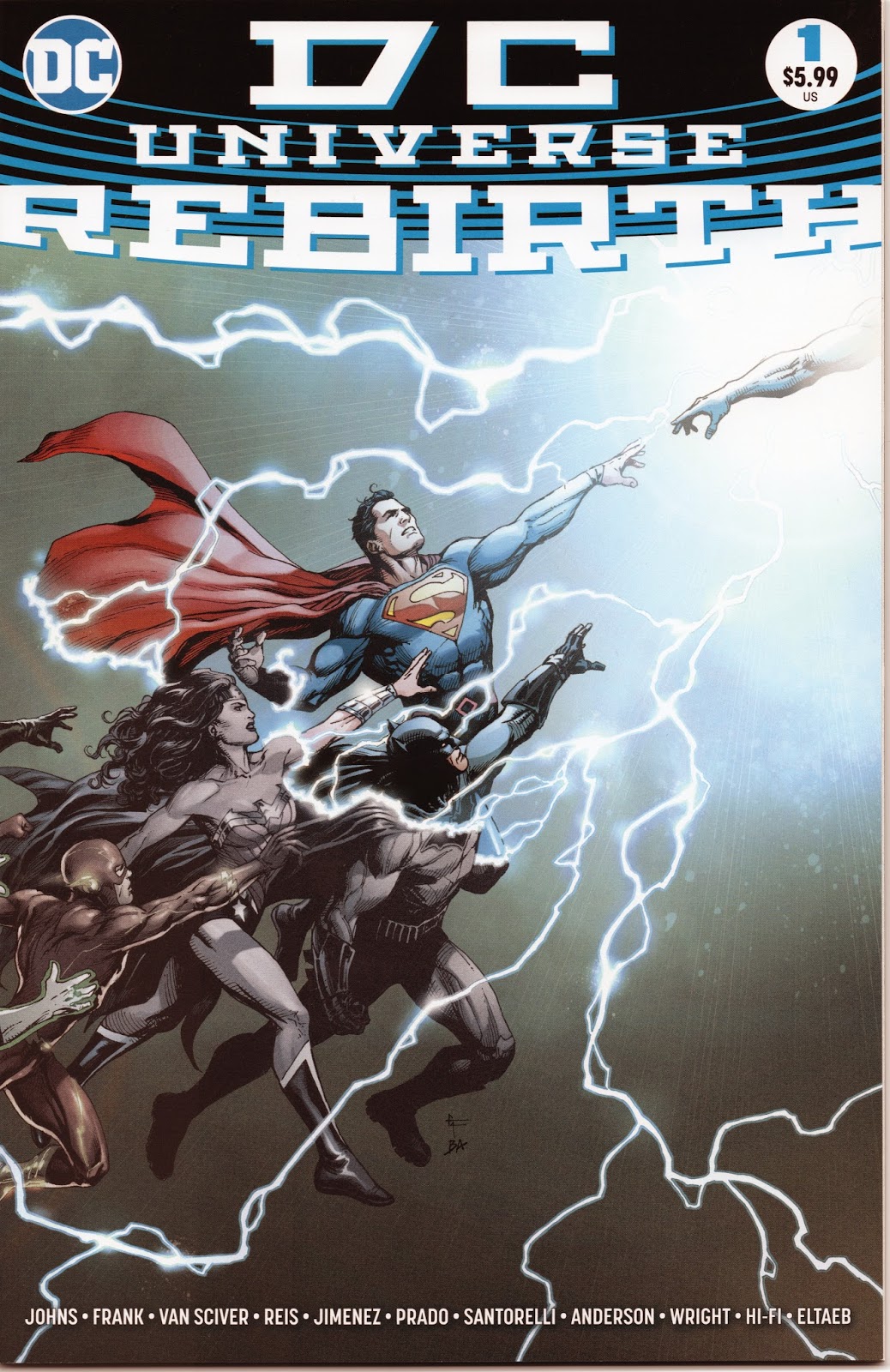
Review- DC Universe: Rebirth #1

There was no true cover image of the second printing online, so I scanned my copy. 

Continuity is the best and worst thing about comic books. The modern day fan hates it with a passion, using the argument that since they are all make believe stories, anything should go so long as they like it and don't deem it to be offensive. The older fans (as in 40+ year olds like myself) believe that continuity is what makes the serial nature of comic books so important and unique. The story never ends because the story never has to. It's all a piece of a giant jigsaw puzzle and it should all fit together neatly.

Unlike television or movies, these characters can age at a fraction of the time that the audience does. The people that bought the earliest adventures of Batman and Superman off of the stands are either dead or are very old, and it is unlikely that they are still following them. Which gives us the argument of change. Characters can change with the times, but the times should not change the core of the character. The New 52 was an attempt at rebooting, updating, and streamlining things. DC's last attempt at this in the 1980s was successful. The New 52 was successful at first but fans left in droves as it went on. The changes to many characters were so drastic that many fans felt like DC abandoned the core of the characters at the expense of the here and now. Comic books have always been an escapist pleasure. Where do you go when the real world, in all of it's ugliness and chaos, becomes the modern day escapist superhero? Deconstruction-style writing destroyed the classic superhero. Now it is time to destroy deconstruction.

DC Universe: Rebirth #1 (DC, Second Printing, cover date July, 2016; Squarebound softcover)

Writer: Geoff Johns

Artists: Gary Frank, Ethan Van Scriver, Ivan Reis, Joe Prado, Phil Jimenez, Matt Santorelli, and Frank Prado

Colorists: Brad Anderson, Jason Wright, Brad Anderson, Hi-Fi, and Gabe Eltaeb

I was in a comic shop the day that the first printing came out. 80 pages of stories for three bucks? Nah. Pass. Lots of hubbub ensued over the next few days online, and I thought about going out to snag a copy, only to find it sold out. A sqarebound second printing with a $5.99 MSRP was announced to go on sale two weeks later. It's like a skinny trade...for six bucks. Why not? Apparently this too has sold out, as there is a third printing available as well.

S-P-O-I-L-E-R-S from here on out. If you haven't had this spoiled yet elsewhere and still don't want it spoiled by this late date, then turn back now.


The story is divided into four chapters and an epilogue, with the thread of it all being The Flash, the Wally West version. He uses the Speed Force to break through into the world as it currently stands, trying to get everyone to remember what was been wiped away. He starts by enlisting the help of the world's greatest detective, Batman. We see various heroes from various Earths (Johnny Thunder as an old man in a nursing home, for example), and things are all tied together with Flash/ Kid Flash/ Wally West.

The cliffhanger, of course, is in the apparent integration of the Watchmen into the main DC Universe. Alan Moore will undoubtedly be casting spells and doing hexes on Geoff Johns over this.


I'll admit that the initial reports that DC is going to ret-con the New 52 continuity away by integrating the Watchmen into a new/old continuity sounded like the most godawful idea that I've ever heard. It still sounds like a terrible idea after reading this. Much like Spider-Man making a deal with the devil himself, Mephisto, to save his Aunt May's life in exchange for erasing his marriage with Mary Jane Watson in One More Day was a terrible idea that resulted in a lot of good comics, let's hope that the uncomfortable, awful excuse that Doctor Manhattan created the New 52 and made people forget the real DC Universe is quickly swept under the rug and never mentioned again so that things can move forward so we can have classic continuity with modern sensibilities. In short, how you get back there is unimportant, so long as you get there.
Junk Food For Thought rating: 3 out of 5.

The OCD zone- Is it a comic? Is it a prestige format book? Is it a skinny graphic novel? 80 pages, squarebound...I don't know what you would call this.

Paper stock: Good weight glossy coated stock.

Binding: Perfect bound.

Cardstock cover notes: The laminated cover is super flexible, more like a very thick paper or a very thin cardstock. I like how the books lies flat in your hand like a big comic book. 

Tuesday, August 2, 2016

Review- THE ADDAMS FAMILY: AN EVILUTION


THE ADDAMS FAMILY: AN EVILUTION (Pomegranate, Second Printing, 2010; Hardcover)

Collects The Addams Family strips and art from 1939-2007

Writer and Artist: Charles Addams

Generations of people love The Addams Family. They are a part of our culture, whether you were there when the show originally aired or you watched it in reruns in syndication in the '70s and later (like I did) or discovered them later on with the movies. They were a precursor to Goth fashions and a reminder of a brief window of time when the macabre could be sold off as wholesome family entertainment.

While far from complete, The Addams Family: An Evilution is a nice overview of the beginning and progression of the characters in their comic strip form. They first appeared in The New Yorker Magazine in 1939 and were featured throughout the decades until they were given their own prime time television series in 1964. Some of the earlier versions of these characters are a far cry from what they would become (Lurch being the finest example), while others were fully formed right out of the gate. I found the story behind Thing and It, or Cousin It as fans of the show would know It, to be fascinating.

The first appearance of Lurch. He is on the right.

This is a fast read, as there is very little text in the strip itself. Only the introductions will take you time to read. The strip was often wordless, and you had to sit there and pore over the page, looking for clues and hints about what was going on to fill in the blanks.


This book would appeal more to pop culture fans than completist collected edition fans, as the series is incomplete and presented out of original publication order. Fans have been spoiled by complete Archives and Blu-Ray boxsets that throw in the kitchen sink. There are many other Addams Family strip books out there, but none of them seem to be chronological or complete. I borrowed this from my local library after years of hemming and hawing about buying it. It was an enjoyable read but I feel no need to own it now.
Junk Food For Thought rating: 3.5 out of 5.

The OCD zone

Linework and Color restoration: I have no source material to compare it to. Everything looks good to my eyes.

Paper stock: This has to be the thickest coated stock paper that I have ever seen. It has a slight sheen and is very nice.

Binding: Smyth sewn binding, lies perfectly flat.

Dustjacket and Hardback cover notes: The library uses Brodart sleeves and then fastens the dustjacket to the hardback itself, so I cannot accurately review the materials.